IT business setup Abu Dhabi
IT Business Setup in Abu Dhabi: Mainland vs Free Zone
Compare mainland vs free zone options for IT business setup in Abu Dhabi, including licensing, ownership, market access and company formation requirements.
Abu Dhabi has become an attractive destination for entrepreneurs, technology professionals, startups, and international companies looking to establish an IT business in the UAE. The emirate's growing technology ecosystem, advanced infrastructure, strong connectivity, and support for innovation create opportunities for businesses involved in software development, IT consultancy, cybersecurity, cloud computing, artificial intelligence, digital transformation, web development, managed IT services, and other technology-related activities. Abu Dhabi also welcomes local and foreign investors and provides different business setup options through its mainland and free-zone ecosystems.
One of the most important decisions for an entrepreneur establishing an IT company is choosing between Abu Dhabi mainland and a free zone. Both options can provide advantages, but they are designed for different business requirements. Mainland businesses generally offer wider access to the UAE local market, while Abu Dhabi's free zones provide sector-focused infrastructure, streamlined setup services, and benefits such as 100% foreign ownership and repatriation of capital and profits. Some free zones also provide dual-licensing options that can allow eligible companies to operate outside the free-zone area.
Therefore, there is no universal answer to whether mainland or free zone is better for an IT company. The right choice depends on the company's activities, target customers, office requirements, ownership structure, budget, and long-term expansion plans. An entrepreneur serving UAE-based corporate clients may have different requirements from a software startup operating primarily online or a technology company developing specialised products for international markets. Understanding the differences before registering the company can help investors select a structure that supports their business goals and avoids unnecessary changes later.
What Is an IT Business in Abu Dhabi?
An IT company can operate across a wide range of technology-related activities, depending on the activity included in its economic licence.
Examples include:
● Software development
● IT consultancy
● Computer programming
● Web development
● Mobile application development
● Cybersecurity services
● Cloud computing
● Data analytics
● Artificial intelligence solutions
● Digital transformation
● IT infrastructure management
● Technical support
● Software and technology trading
The exact activity should be selected according to the actual services the company intends to provide.
Abu Dhabi Mainland for IT Companies
What Is a Mainland IT Company?
A mainland IT company is established under Abu Dhabi's mainland business licensing framework. Mainland businesses can generally conduct business throughout the UAE, giving them broad access to the local market.
For an IT company that plans to work directly with UAE customers, companies, government-related organisations, or clients across different emirates, mainland establishment can be an attractive option.
Advantages of Mainland IT Setup
1. Wider UAE Market Access
One of the main advantages of mainland establishment is the ability to conduct business throughout the UAE.
This can be particularly useful for IT companies providing:
● On-site IT support
● Corporate technology services
● IT consultancy
● Software implementation
● Digital transformation
● Technology solutions for UAE businesses
2. Flexible Business Activities
A mainland company can select from the economic activities permitted by Abu Dhabi's licensing framework, subject to the requirements applicable to each activity.
3. Suitable for Local Clients
If most customers are located in Abu Dhabi or elsewhere in the UAE, mainland establishment can provide a straightforward structure for serving the local market.
4. No Minimum Capital for Most Activities
Abu Dhabi states that there is no minimum capital requirement for most mainland business activities.
5. Options for Foreign Investors
Abu Dhabi provides foreign investors with ownership opportunities across many business activities, subject to the applicable rules.
Abu Dhabi Free Zones for IT Companies
What Is a Free-Zone IT Company?
A free-zone IT company is established within one of Abu Dhabi's designated economic zones. Free zones are generally organised around particular industries and provide infrastructure and services designed to support companies operating within those sectors.
For technology businesses, the suitability of a particular free zone depends on its permitted activities and sector focus.
Advantages of Free-Zone IT Setup
1. 100% Foreign Ownership
Abu Dhabi free zones offer 100% foreign ownership, which can be particularly attractive to international entrepreneurs and technology companies.
2. Sector-Focused Infrastructure
Free zones can provide infrastructure designed around particular industries. Abu Dhabi's free-zone ecosystem includes zones focused on areas such as finance, media, logistics, manufacturing, aviation, and other sectors.
3. Streamlined Setup Services
Free zones generally provide company formation and support services designed to make establishment more efficient.
4. Repatriation of Capital and Profits
Abu Dhabi states that free zones provide 100% repatriation of capital and profits.
5. Dual-Licensing Options
Some free-zone companies can benefit from dual-licensing arrangements, subject to the applicable requirements. Abu Dhabi's licensing authority specifically lists a Dual Licence that allows establishments registered in Abu Dhabi free zones to conduct activities and manage their business outside the free-zone area.
Mainland vs Free Zone: Key Difference
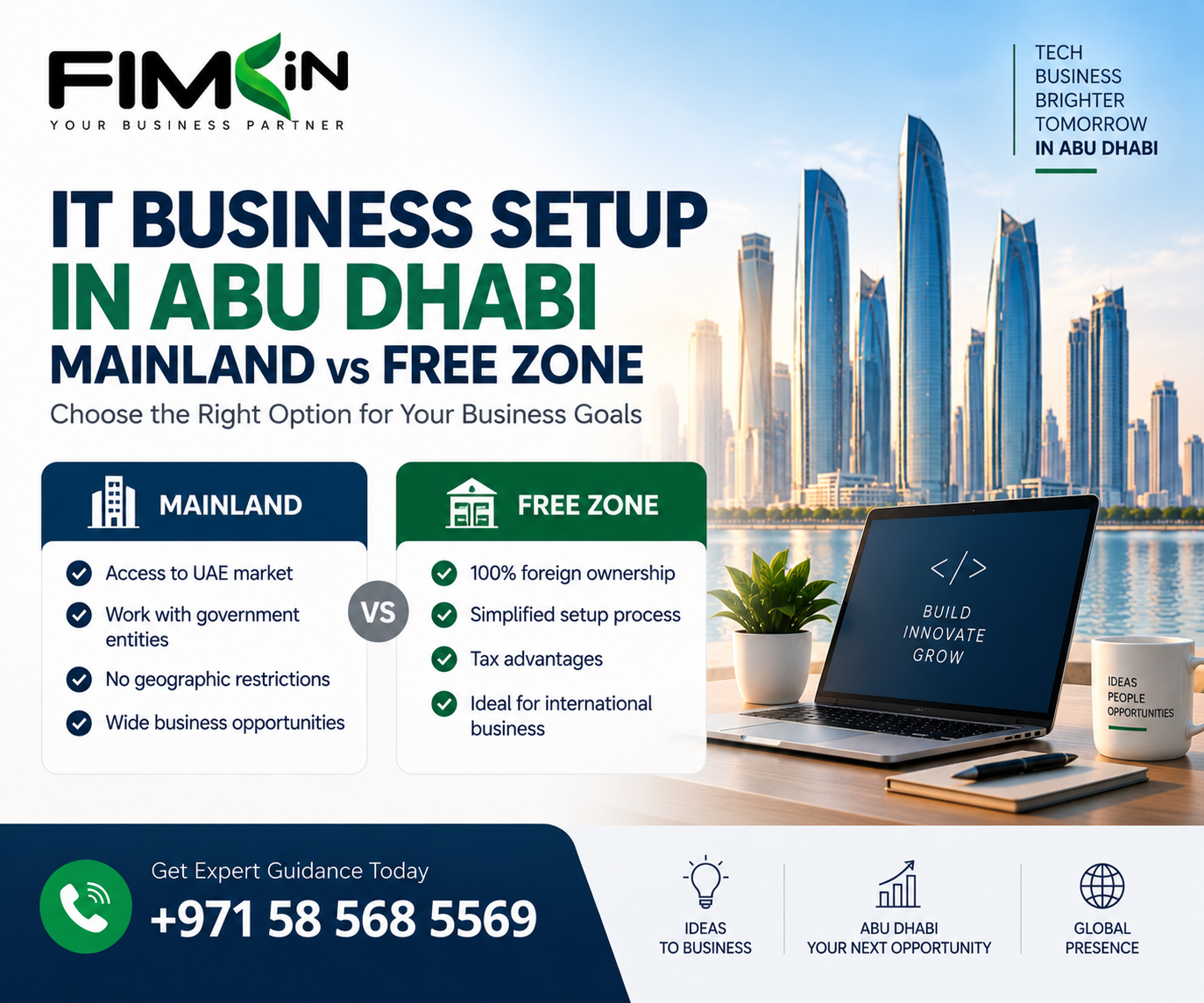
The mainland option is best for IT companies that want to work directly with clients across the UAE and have broader local market access. A free zone is often suitable for businesses focused on international clients, specialised technology activities, and benefits such as 100% foreign ownership.
Which Is Better for an IT Company?
There is no single answer. Your business model should determine the choice.
Choose Mainland If:
A mainland IT company may be more suitable if you:
● Want broad access to UAE customers
● Plan to provide services across different emirates
● Need a conventional Abu Dhabi office
● Expect significant local corporate business
● Want flexibility in serving onshore clients
Choose Free Zone If:
● A free-zone IT company may be attractive if you:
● Want 100% foreign ownership
● Prefer a technology-focused or specialised business ecosystem
● Primarily serve international clients
● Want sector-specific infrastructure
● Prefer a streamlined free-zone setup
● May benefit from a dual-licensing option
The final decision should be based on the company's actual activities and intended customers rather than choosing a jurisdiction simply because it has a lower advertised setup price.
How to Set Up an IT Company in Abu Dhabi Mainland
Step 1: Choose Your IT Activity
Determine the exact IT service you intend to provide.
Step 2: Select the Legal Form
Choose an appropriate legal structure based on your ownership and business requirements.
Step 3: Reserve the Trade Name
Register a suitable trade name with the relevant Abu Dhabi authority.
Step 4: Obtain Initial Approval
Apply for initial approval before proceeding with the remaining setup requirements.
Step 5: Arrange Business Premises
Find an appropriate office or other approved business location where required and obtain the relevant tenancy documentation.
Step 6: Obtain Additional Approvals
If your particular IT activity is regulated, obtain any additional approvals required by the relevant authority.
Step 7: Obtain the Final Economic Licence
Submit the required documents and complete the applicable payments to obtain the final licence. Abu Dhabi's official process includes activity selection, legal-form selection, trade-name registration, initial approval, premises, additional approvals where required, and final licensing.
How to Set Up an IT Company in an Abu Dhabi Free Zone?
Step 1: Select a Suitable Free Zone
Choose a free zone whose permitted activities match your IT business.
Step 2: Select Your Business Activity
Identify the exact technology activity you want to conduct.
Step 3: Choose the Legal Structure
Select the appropriate free-zone company structure.
Step 4: Reserve the Company Name
Choose and register an acceptable company name according to the free zone's requirements.
Step 5: Submit the Required Documents
Provide shareholder, corporate, business-plan, and other documents requested by the free-zone authority.
Step 6: Arrange the Required Office
Select an office, workstation, or other approved facility according to the free zone's requirements and your licence package.
Step 7: Obtain the Free-Zone Licence
Complete the required procedures and receive the relevant free-zone business licence.
Documents Required for an IT Company
Requirements vary according to the chosen jurisdiction and legal structure. Common documents may include:
● Passport copies of shareholders
● Emirates ID, where applicable
● Visa documents, where applicable
● Trade name documents
● Application forms
● Business activity details
● Memorandum of Association, where applicable
● Tenancy documents, where required
● Corporate documents for foreign shareholders
● Additional approvals, where applicable
Foreign companies establishing branches may need additional parent-company documents and resolutions.
How Much Does IT Business Setup Cost in Abu Dhabi?
There is no single fixed cost for an IT company because expenses depend on whether the company is established on the mainland or in a free zone, the chosen activity, office requirements, number of visas, and other operational needs.
Typical expenses may include:
● Business licence
● Company registration
● Trade-name reservation
● Office rent
● Free-zone establishment package
● Visa costs
● Government fees
● Professional services
● Computers and equipment
● Software subscriptions
● Insurance
● Marketing
● Working capital
A small IT consultancy operating with a modest office can have a very different cost structure from a technology company employing a large development team.
Mainland vs Free Zone for IT Startups
For a small IT startup, the decision should be based on where the company expects to generate most of its revenue.
If the startup is primarily developing software for international customers and wants a specialised business environment, a suitable free zone may be worth considering.
If the startup expects to provide IT consultancy, implementation, technical support, or other services directly to UAE-based businesses, mainland establishment may offer greater practical flexibility.
Abu Dhabi also provides a Freelancer Licence for eligible investors, including foreigners, to practise specified economic activities remotely without requiring physical office premises. However, eligibility depends on the activity and licensing conditions, so entrepreneurs should confirm whether their proposed IT activity qualifies.
Common Mistakes to Avoid
Choosing the Wrong IT Activity
Do not select a generic activity simply because it appears inexpensive. Make sure the activity accurately reflects your services.
Choosing a Free Zone Based Only on Price
The cheapest package is not necessarily the best option. Consider permitted activities, office requirements, customer location, visa options, and future expansion.
Ignoring Local Market Access
If most customers will be UAE mainland businesses, understand how your chosen free-zone structure affects your ability to serve them.
Renting an Office Too Early
Confirm the premises requirements for your specific licence before signing a long-term lease.
Forgetting Additional Approvals
Certain technology activities may have additional regulatory requirements.
How Fimkin Can Help?
Fimkin Business Services can assist entrepreneurs with IT business setup in Abu Dhabi, including company formation, documentation, licensing procedures, and coordination with relevant authorities.
Business Setup in Abu Dhabi :https://www.fimkinonline.com/services/58e1b473-7dfe-4b36-8d9f-c41d249d2d08
Conclusion
Choosing between mainland and free zone is one of the most important decisions when establishing an IT company in Abu Dhabi. Both options can provide an effective foundation for technology businesses, but their advantages are not identical. Mainland establishment offers broad access to the UAE local market and can be particularly suitable for IT consultancies, technology service providers, software implementation companies, and businesses expecting to work extensively with UAE-based customers. Free zones, on the other hand, can provide 100% foreign ownership, sector-focused infrastructure, streamlined setup services, and other benefits that may appeal to technology startups and internationally focused companies.
The decision should therefore be based on the company's actual business model rather than simply comparing licence prices. Entrepreneurs should consider their intended IT activities, target customers, location, office requirements, staffing needs, ownership structure, expected operating costs, and long-term expansion plans. A business that primarily serves UAE companies may benefit from the flexibility of a mainland structure, while a technology startup focused on international clients may find a suitable free zone more aligned with its objectives.
The setup process itself involves several important stages, including selecting the correct IT activity, choosing the legal structure, registering the trade name, obtaining initial approval, arranging suitable premises where required, securing any additional approvals, and obtaining the appropriate economic licence. Abu Dhabi's official licensing framework provides different routes depending on the nature and requirements of the business.
Ultimately, the best jurisdiction is the one that supports the company's customers, operations, compliance requirements, and future growth. By evaluating mainland and free-zone options carefully before incorporation, entrepreneurs can avoid unnecessary restructuring and build a more suitable foundation for their IT business. With proper planning and professional business setup support, technology entrepreneurs and international companies can establish their IT operations in Abu Dhabi and position themselves for sustainable growth in the UAE's expanding digital economy.
Frequently Asked Questions (FAQs)
1. Is mainland or free zone better for an IT company in Abu Dhabi?
Neither is universally better. Mainland is generally attractive for businesses targeting the UAE local market, while free zones can be suitable for companies seeking specialised infrastructure, 100% foreign ownership, and other free-zone benefits.
2. Can foreigners own an IT company in Abu Dhabi?
Yes. Foreign ownership is available for many activities, and Abu Dhabi free zones provide 100% foreign ownership.
3. Can a free-zone IT company serve UAE customers?
This depends on the applicable licensing and market-access rules. Certain free-zone establishments may use dual licensing where eligible.
4. Does an IT company need an office in Abu Dhabi?
The requirement depends on the activity and licensing route. Abu Dhabi also has certain licensing options for eligible businesses that do not require physical premises.
5. What IT activities can I register?
Possible activities include software development, programming, IT consultancy, cybersecurity, cloud services, and other technology-related activities, subject to the activities available under the chosen licence.
6. Can an international IT company open a branch in Abu Dhabi?
Yes, subject to the applicable branch registration, licensing, and documentation requirements.
7. Is there a minimum capital requirement?
Abu Dhabi states that there is no minimum capital requirement for most mainland business activities. Specific structures or activities may have different requirements.
8. Can I start an IT company remotely?
Certain eligible activities may be available through licensing options that do not require physical premises, but eligibility depends on the activity and licence.