UAE e-commerce business setup
UAE E-Commerce Business Setup: Mainland or Free Zone?
Planning to start an e-commerce business in the UAE? Compare Mainland vs Free Zone setup, licensing, benefits and key considerations. Get expert business setup support from FimkinOnline.
E-commerce has become an important part of the UAE's business environment, allowing entrepreneurs to sell products and services through websites, mobile applications, social media platforms and other digital channels. But before launching an online business, entrepreneurs need to decide where to register the company and which licence structure matches the business model.
The UAE offers both mainland and free zone options for e-commerce businesses. Free zones can provide specialised e-commerce licences and business ecosystems, while mainland licensing can provide a structure for businesses intending to operate directly in the wider UAE market. The UAE Ministry of Economy and Tourism confirms that e-commerce is among the licence categories available in free zones, while mainland businesses select their licence based on the nature of their economic activity.
The right choice therefore depends on factors such as the target customers, products being sold, warehouse requirements, delivery model, office needs, ownership, budget and future expansion plans. Rather than choosing a jurisdiction based only on the initial licence price, entrepreneurs should look at how the company will actually operate.
What Is an E-Commerce Business in the UAE?
An e-commerce business sells products or services through digital channels rather than relying entirely on a traditional physical shop. This can include an online store, marketplace, mobile application or social media-based business, depending on the permitted activity and licence.
Examples include:
● Online fashion stores
● Electronics and consumer goods
● Beauty and personal-care products
● Home and lifestyle products
● Digital products and services
● Online consulting
● Subscription-based services
● Online marketplaces
● Import and online resale businesses
The exact business activity should be identified before applying for a licence because the activity determines the applicable licensing requirements and can affect the legal structure. The UAE government states that there are more than 2,000 economic activities available for businesses.
UAE Mainland E-Commerce Business Setup
A mainland e-commerce company is established through the relevant emirate's economic department. The business activity, legal structure, trade name, location and any additional approvals need to be considered as part of the setup process.
A mainland structure can be considered by entrepreneurs who want to build a business serving customers throughout the UAE and who may eventually combine online sales with physical operations such as a showroom, shop, office or warehouse.
When Could Mainland Be Considered?
Mainland may be worth examining if the entrepreneur plans to:
● Sell directly to UAE customers
● Operate a physical retail location alongside an online store
● Maintain a UAE office or warehouse
● Work with local businesses
● Expand beyond a purely online operation
● Build a broader UAE retail presence
The UAE Ministry of Economy and Tourism states that mainland businesses can generally operate through the applicable economic department licensing framework, with the activity determining the licence and legal form.
UAE Free Zone E-Commerce Business Setup
Free zones provide another route for establishing an online business. The UAE Ministry of Economy and Tourism specifically lists e-commerce licences among the types of licences available in free zones. Free zones also offer different legal structures, office options and sector-specific ecosystems depending on the individual authority.
This can be useful for entrepreneurs who want a specialised business environment or who are building an online business focused on international customers, digital operations, trading or re-export.
Free zone requirements vary considerably, so entrepreneurs should compare individual zones rather than assuming that every free zone provides the same facilities or conditions.
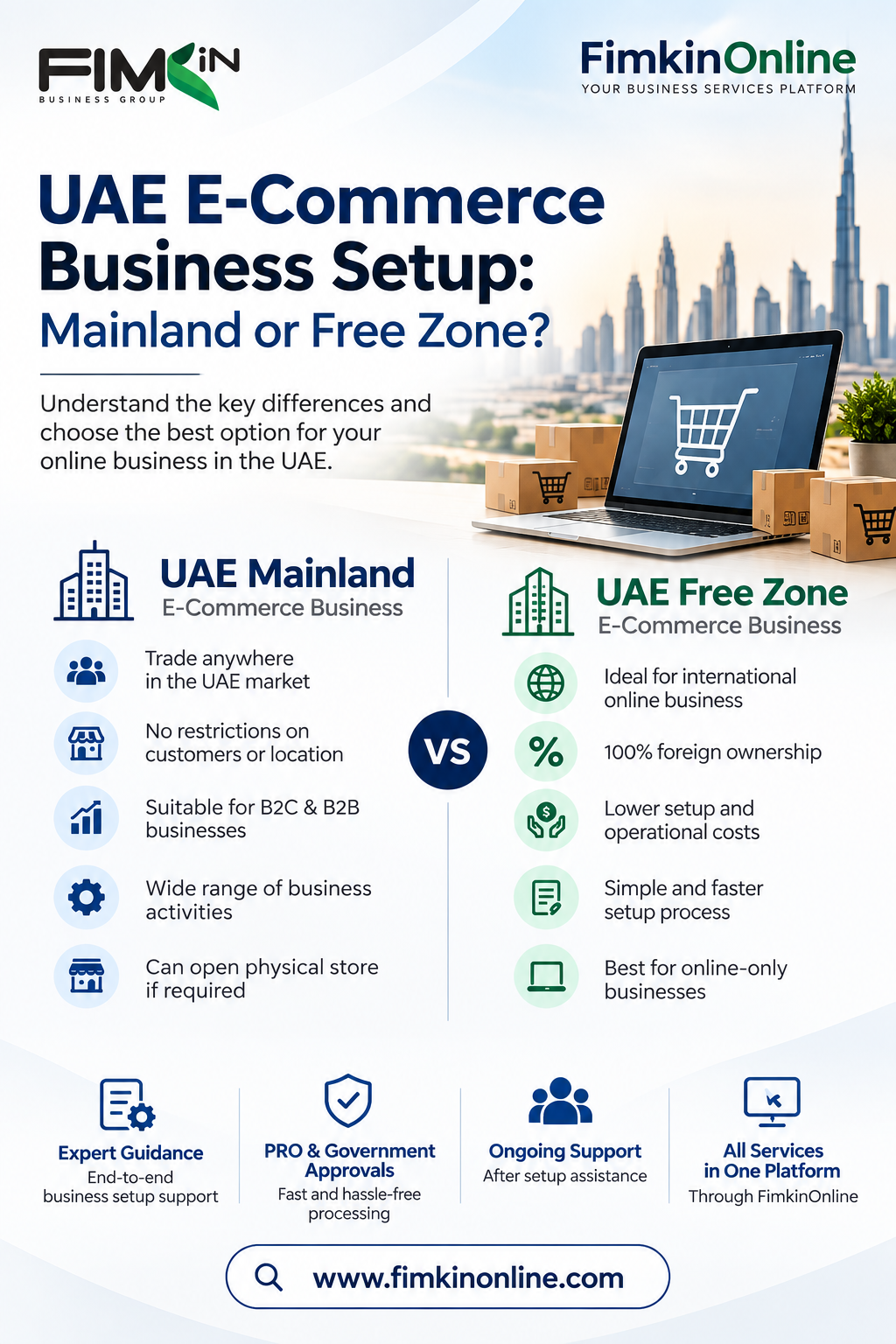
Mainland vs Free Zone: Key Differences
The decision becomes easier when the entrepreneur looks at how the business will operate.
1. Target Market
If the main customer base is in the UAE mainland, entrepreneurs should carefully examine mainland licensing and the rules governing a free zone company's mainland activities.
A free zone company does not automatically have unrestricted access to the mainland simply because it has a UAE trade licence. The applicable permissions and arrangements depend on the business activity and current regulations.
2. Business Location
Mainland businesses must comply with the location requirements of the relevant emirate. The UAE government states that mainland businesses generally require an actual address that meets the applicable zoning and authority requirements.
Free zones offer their own office and facility options. These can include offices, shared facilities, warehouses and, for certain eligible licences, virtual-office arrangements. Requirements vary by free zone and activity.
3. Foreign Ownership
Foreign entrepreneurs can establish and fully own companies in many UAE business structures. The Ministry of Economy and Tourism states that investors of all nationalities can establish and fully own companies in the UAE, subject to applicable rules and activity restrictions.
Free zones also commonly provide 100% foreign ownership, although the exact structure and requirements depend on the relevant free zone authority.
4. Warehousing and Inventory
An online store selling physical products needs to think beyond the website.
The entrepreneur may need:
● Storage space
● Inventory management
● Packaging facilities
● Delivery arrangements
● Import and customs procedures
● Product-specific approvals
A free zone with suitable warehouse and logistics facilities can be relevant for businesses with significant inventory. Mainland businesses can also arrange suitable warehouses, subject to the applicable activity and premises requirements.
5. Product Regulations
Not every product can simply be imported and sold online.
Depending on the products, businesses may need additional approvals or compliance requirements. Products such as food, cosmetics, medical products, supplements and certain specialised goods can be subject to sector-specific rules.
The UAE's consumer protection legislation applies to goods and services in the UAE, including relevant e-commerce transactions.
Entrepreneurs should therefore identify the products they intend to sell before selecting the final business activity.
What About Social Media Businesses?
Selling through Instagram, Facebook, TikTok or other social platforms is still a business activity when conducted commercially.
An entrepreneur should not assume that avoiding a physical shop means no business licence is necessary. The appropriate licensing route depends on the business activity, the emirate and the way the business operates.
For example, certain jurisdictions offer specialised online or e-commerce licensing options, while some free zones have dedicated e-commerce licences. The UAE Ministry of Economy and Tourism lists e-commerce among the available free zone licensing categories.
Choosing the Right Free Zone for E-Commerce
If an entrepreneur decides that a free zone is suitable, the next question is which free zone?
There are more than 40 free zones in the UAE, with different specialisations and licensing arrangements.
When comparing free zones, entrepreneurs should examine:
● E-commerce licence availability
● Permitted business activities
● Office requirements
● Warehouse facilities
● Logistics connections
● Visa packages
● Number of shareholders
● Import and export arrangements
● Customer location
● Renewal costs
● Ability to expand activities
For example, a business focused heavily on warehousing and physical goods may have different requirements from a small online service provider.
What Documents Are Usually Required?
The exact documentation depends on the jurisdiction and company structure.
Common documents can include:
● Passport copies of shareholders
● Manager's passport copy
● Proposed company name
● Completed application forms
● Business activity details
● Business plan where required
● Memorandum and Articles of Association where applicable
● Office or facility documents
● Additional approvals for regulated products or activities
The Ministry of Economy and Tourism notes that free zone applications can require documents such as passport copies, business plans, manager information and constitutional documents, depending on the company and application.
Basic Steps for UAE E-Commerce Company Formation
Although the exact process differs between jurisdictions, entrepreneurs can generally expect to:
Step 1: Define the Business Activity
Decide exactly what will be sold or provided online.
Step 2: Choose Mainland or Free Zone
Compare the customer base, operational model, premises and future plans.
Step 3: Select the Legal Structure
Choose the structure permitted for the selected activity and jurisdiction.
Step 4: Reserve the Trade Name
The proposed business name must comply with the applicable naming rules.
Step 5: Arrange the Business Address
Choose the required office, workspace, warehouse or other approved facility.
Step 6: Obtain Additional Approvals
Check whether the products or services require approval from another authority.
Step 7: Apply for the Licence
Submit the required documents, pay the applicable fees and complete the registration process.
The UAE's general company-formation process follows the same basic principle: identify the activity, determine the legal structure, register the trade name, select the business location, obtain required approvals and receive the licence.
How Much Does UAE E-Commerce Business Setup Cost?
There is no single fixed cost for setting up an e-commerce business in the UAE.
The final cost can depend on:
● Mainland or free zone jurisdiction
● Business activity
● Legal structure
● Number of shareholders
● Office requirements
● Number of visas
● Warehouse requirements
● Additional approvals
● Licence and registration fees
● Renewal costs
A low-cost package may not necessarily be the most suitable option if the business later needs a warehouse, additional visas or activities that were not included in the original licence.
How Fimkin Can Help with UAE E-Commerce Business Setup?
Choosing between mainland and free zone can be confusing when entrepreneurs have to consider licensing, customer access, office requirements, warehousing, visas and product approvals at the same time.
Fimkin can assist with business activity selection, jurisdiction comparison, company structure, documentation, licence applications and coordination with the relevant authorities. This allows entrepreneurs to establish their e-commerce business according to their actual operating model rather than simply choosing a licence based on price.
Launch your business in abudhabi :
https://www.fimkinonline.com/services/58e1b473-7dfe-4b36-8d9f-c41d249d2d08
Fimkin can also help entrepreneurs assess the setup requirements before proceeding with the incorporation process.
Conclusion
Choosing between mainland and free zone for a UAE e-commerce business depends largely on how the business will operate and where it plans to serve customers. Mainland licensing can be relevant for businesses intending to build a direct presence in the UAE market, while free zones offer specialised e-commerce options and different business ecosystems.
Entrepreneurs should consider the business activity, customer base, ownership, office and warehouse requirements, delivery model, product regulations, visa needs and future expansion before making the decision. The cheapest licence is not necessarily the right licence if it does not match the company's actual activities.
With careful planning, entrepreneurs can choose a UAE e-commerce setup that fits their business model and provides a practical foundation for future growth.
Frequently Asked Questions (FAQs)
1. Is mainland or free zone better for e-commerce in the UAE?
Both options have different features. The appropriate choice depends on the business activity, target customers, facilities and future plans.
2. Can foreigners own an e-commerce company in the UAE?
Yes. 100% foreign ownership is available for many UAE business structures, subject to the applicable activity and jurisdiction rules.
3. Can a free zone company sell to UAE customers?
A free zone company can conduct its permitted activities, but direct mainland sales and physical operations are subject to the applicable licensing and regulatory arrangements.
4. Does an online store need a UAE business licence?
Commercial online activities generally need to comply with the applicable UAE licensing requirements.
5. Can I sell products through Instagram without a physical shop?
The absence of a physical shop does not automatically remove licensing requirements. The appropriate licence depends on the business model and jurisdiction.
6. Does an e-commerce company need a warehouse?
Not necessarily. It depends on whether the business holds physical inventory and the requirements of its chosen activity and jurisdiction.
7. Can an e-commerce company import products into the UAE?
Importing physical products involves customs and potentially product-specific requirements in addition to the business licence.
8. Can Fimkin help with UAE e-commerce company formation?
Yes. Fimkin can assist with choosing the appropriate setup route, preparing documents, applying for the licence and coordinating the company formation process.