
UAE business licence
All Businesses in UAE: Which Licence Structure Should Entrepreneurs Consider?
Starting a business in the UAE? Compare Mainland, Free Zone, ADGM and other licence structures to understand which option may best suit your business activity, market and growth plans.
Starting a business in the UAE involves more than choosing a business idea and registering a company. Entrepreneurs need to decide where the business should be established, what economic activity it will conduct, which licence is appropriate, and what legal structure fits the business. These decisions can affect ownership, market access, office requirements, visas, compliance obligations and future expansion.
The UAE offers several business setup routes, including mainland companies, free zone companies, branches and specialised structures. The appropriate option depends on the nature of the business and the entrepreneur's operational plans. The UAE Ministry of Economy and Tourism states that selecting the economic activity is an important first step because the activity influences both the licence type and the permitted legal form.
For this reason, entrepreneurs should not choose a licence simply because it appears cheaper or easier to obtain. A structure that works well for a consultancy may not be suitable for a manufacturing company, retail business or international trading operation.
Understanding the Main UAE Business Licence Structures
There is no single licence structure that suits every business in the UAE. Entrepreneurs generally consider mainland licensing, free zone licensing, specialised jurisdictions and branch structures.
The first decision is usually whether the company should operate under a mainland authority or within a free zone. After that, the entrepreneur needs to select the appropriate economic activity and legal form.
Mainland Business Licence
A mainland company is licensed by the relevant economic authority of the emirate where the business is established. Mainland businesses can generally operate within the UAE market, subject to the rules applicable to their activity and licence.
In Dubai, for example, mainland businesses are registered and licensed through the Dubai Department of Economy and Tourism (DET). Available licence categories include Commercial, Industrial, Professional and E-Trader licences, among others.
A mainland structure may be considered by entrepreneurs who plan to:
● Sell products or services directly in the UAE market
● Open physical shops or offices
● Work with local customers and businesses
● Conduct commercial or professional activities
● Expand operations across the UAE
● Participate in certain government or corporate opportunities
The exact requirements depend on the selected activity and legal form.
Free Zone Business Licence
UAE free zones are designed around different industries and business models. Many offer specialised ecosystems for sectors such as technology, media, commodities, logistics, manufacturing, finance and e-commerce.
Free zones generally provide options such as Free Zone Establishments, Free Zone Companies and branches, although the structures available vary between individual free zones. The Ministry of Economy notes that the permitted legal form depends on the activity and the rules of the relevant free zone authority.
Free zone companies can be attractive to entrepreneurs who:
● Focus on international trade or re-export
● Want to operate within a specialised business ecosystem
● Need sector-specific facilities
● Want access to free zone office or warehouse solutions
● Are establishing a consultancy, technology or online business
● Prefer a jurisdiction offering full foreign ownership where permitted
However, entrepreneurs should understand the rules for conducting business in the UAE mainland. A free zone company does not automatically have unrestricted access to the mainland market. The applicable licence, permit or branch arrangement depends on the activity and emirate.
Commercial Licence for Trading Businesses
A Commercial Licence is generally relevant to businesses involved in buying, selling, distribution and other approved commercial activities.
This structure may suit entrepreneurs planning businesses such as:
● General trading
● Wholesale trading
● Retail
● Import and export
● Distribution
● Certain e-commerce activities
● Trading of specific products
The exact activity should be selected carefully because different products can have different regulatory requirements and additional approvals.
For example, businesses dealing with food, pharmaceuticals, cosmetics, precious metals or other regulated products may require approvals from additional government authorities.
Professional Licence for Service Businesses
Entrepreneurs providing professional or specialised services may consider a Professional Licence where the relevant jurisdiction offers it for their activity.
This can apply to businesses such as:
● Consultancy
● Management services
● Design services
● Certain technical services
● Professional advisory activities
● Other approved service-based activities
The exact legal structure and ownership requirements depend on the activity and jurisdiction.
Industrial Licence for Manufacturing
Manufacturing businesses have different requirements from ordinary trading or consultancy companies. Entrepreneurs involved in production, processing or manufacturing may need an Industrial Licence and suitable industrial premises.
Depending on the activity, the business may also require:
● Factory or warehouse facilities
● Environmental approvals
● Product-specific approvals
● Health and safety compliance
● Machinery and equipment approvals
● Import or customs arrangements
Therefore, industrial businesses should assess their facility and regulatory requirements before selecting the company structure.
E-Commerce and Online Business Licensing
An online business still needs to comply with UAE licensing requirements. Entrepreneurs selling products or services through websites, applications or online platforms should identify the correct economic activity and licence before starting operations.
Dubai, for example, has specific e-commerce licensing requirements, and certain e-commerce activities require approval or a No Objection Certificate from the Telecommunications and Digital Government Regulatory Authority (TDRA).
The appropriate structure can depend on whether the entrepreneur is operating independently, establishing a company with shareholders, selling physical products, providing digital services or operating through a specialised free zone.
Branch of a UAE or Foreign Company
Not every entrepreneur is starting a completely new business. An existing company may want to establish a presence in another emirate or jurisdiction.
In such cases, a branch structure may be considered. A branch is legally connected to its parent company rather than being an entirely independent company. Dubai Development Authority, for example, permits branches of UAE and foreign companies in its free zone subject to the applicable requirements.
A branch can be useful when an established company wants to:
● Expand its UAE operations
● Enter another emirate
● Establish a local business presence
● Continue activities related to its parent company
The parent company's documents and approvals may be required during the registration process.
How Should Entrepreneurs Choose the Right Structure?
Instead of starting with the question “Which licence is cheapest?”, entrepreneurs should first consider the business model.
Important questions include:
1. What is the business activity?
The activity is one of the most important factors because it determines the applicable licence category and can influence the legal forms available. The UAE has more than 2,000 economic activities.
2. Where will the customers be?
If the business primarily targets UAE mainland customers, mainland licensing may need to be examined. If the company focuses on international clients, re-export or a specialised industry ecosystem, a free zone may also be considered.
3. Does the business need physical premises?
Office, shop, warehouse or industrial facility requirements can vary according to the activity, number of employees and jurisdiction.
4. How many owners will the company have?
The number and type of shareholders can affect the available legal structure. Free zones, for example, may offer FZE, FZCO/FZ-LLC and branch structures depending on their individual regulations.
5. Will the company need visas?
Visa requirements and quotas can depend on the licence, office or facility and jurisdiction. Entrepreneurs should include these requirements when comparing setup options.
6. Will the company expand later?
A structure that works for a small startup may need to accommodate additional shareholders, employees, branches, warehouses or new activities later. Planning for expansion can help avoid unnecessary restructuring.
Basic Steps for Setting Up a UAE Business
Although procedures differ between emirates and free zones, the general process usually involves:
● Identify the business activity
● Choose the jurisdiction
● Select the legal form
● Reserve the trade name
● Obtain initial approval where required
● Prepare the required constitutional documents
● Arrange the office or business premises
● Obtain additional approvals if applicable
● Submit the application and pay the required fees
● Receive the business licence
The UAE government's mainland setup guidance follows a similar sequence and notes that the business activity should be determined before selecting the legal form and licence.
Documents Entrepreneurs May Need
The exact document checklist depends on the jurisdiction, activity and legal structure.
Common requirements can include:
● Passport copies of shareholders
● Passport copy of the manager
● Passport-size photographs where required
● Proposed trade name
● Application forms
● Memorandum of Association or other constitutional documents
● Lease or office documents
● Business plan for certain activities
● Parent-company documents for branches
● Additional regulatory approvals where applicable
Some activities and structures require additional documentation or approvals, so entrepreneurs should obtain a tailored checklist before submitting an application.
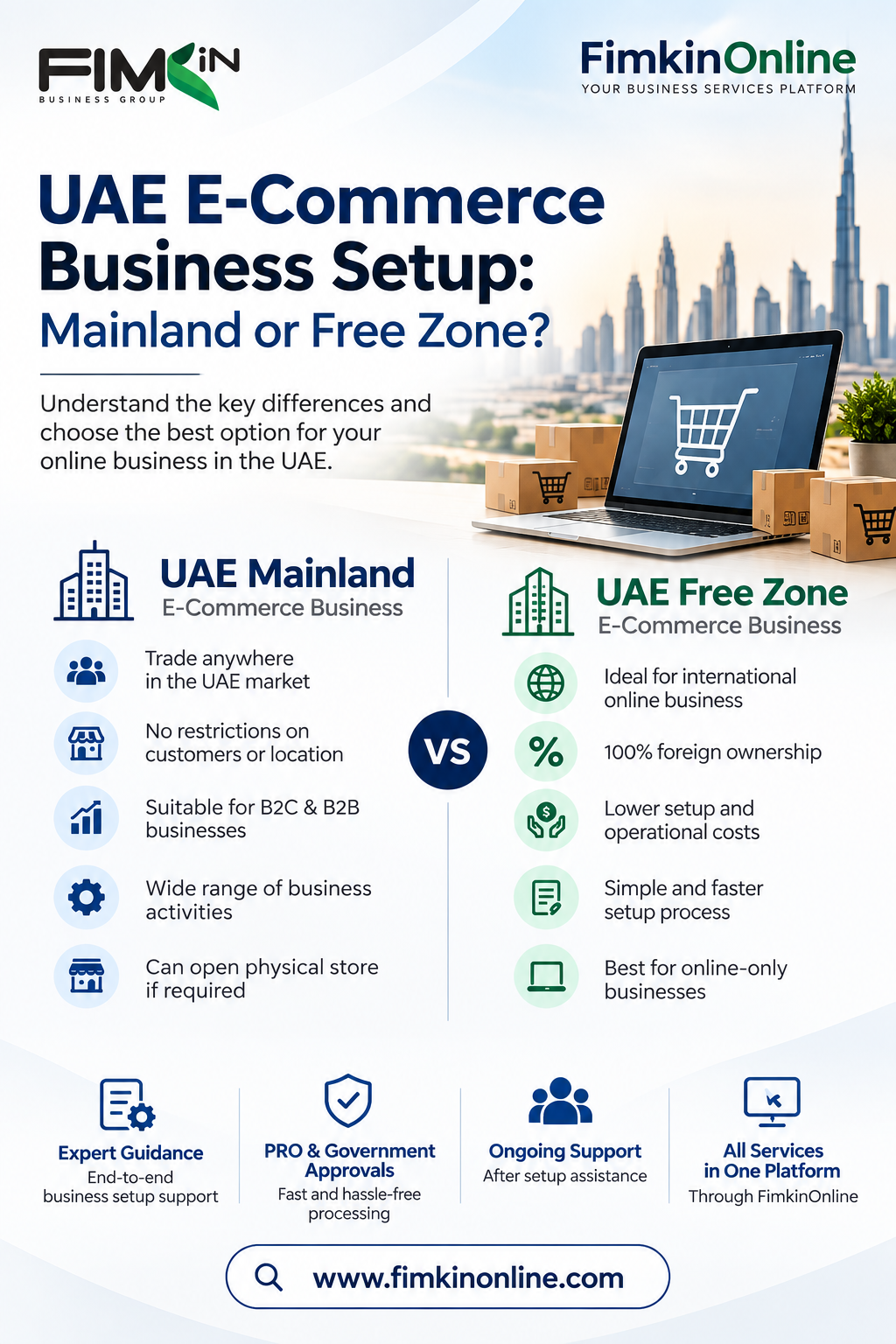
Mainland vs Free Zone: What Should Entrepreneurs Examine?
Both options have different characteristics. Mainland companies generally provide access to the UAE mainland market under the applicable licensing framework, while free zones provide specialised environments and their own regulatory systems.
Dubai's official business setup information notes that free zones can offer 100% foreign ownership and sector-specific environments, while direct mainland trading by a free zone company is subject to the relevant licensing or permit requirements.
Therefore, the choice should be based on factors such as:
● Business activity
● Target customers
● Ownership
● Office requirements
● Number of visas
● Facility requirements
● Import and export needs
● Regulatory approvals
● Expansion plans
Overall setup and operating costs
There is no universal structure that fits every entrepreneur.
How Fimkin Can Help with UAE Business Setup?
Choosing the right licence structure can be difficult when entrepreneurs have to compare activities, jurisdictions, legal forms, office requirements and government procedures.
Fimkin's Business Setup in Dubai service provides support with activity selection, mainland and free zone assessment, trade name reservation, documentation, government submissions, licence issuance and related setup procedures. Fimkin also supports businesses with mainland and free zone company formation across the UAE.
Business setup service:
https://www.fimkinonline.com/services/58e1b473-7dfe-4b36-8d9f-c41d249d2d08
Conclusion
Choosing a UAE business licence structure should begin with the business activity and long-term operating plan, rather than simply comparing licence prices. Mainland, free zone, professional, commercial, industrial, e-commerce and branch structures serve different purposes and come with different requirements.
Entrepreneurs should consider where their customers are located, how the business will operate, whether physical premises are required, how many owners and employees will be involved, and whether the company is likely to expand in the future. Understanding these factors before incorporation can make the setup process more organised and help reduce the risk of selecting a structure that does not match the company's actual needs.
With the right planning and professional guidance, entrepreneurs can identify a UAE business structure that aligns with their activity, operational requirements and growth plans while completing the required licensing and compliance procedures.
Frequently Asked Questions (FAQs)
1. What is the first step in starting a business in the UAE?
The first step is generally identifying the business activity because it influences the licence type and legal structure.
2. Is mainland or free zone better for a UAE business?
Both serve different purposes. The suitable option depends on the business activity, target market, facility needs and expansion plans.
3. Can foreigners own a UAE company?
Many UAE mainland activities and free zone structures permit 100% foreign ownership, although specific activities can have additional requirements.
4. What licence is suitable for a trading business?
A Commercial Licence is generally used for approved trading activities, but the exact activity must be selected according to the products and operations.
5. Does a manufacturing company need a special licence?
Manufacturing activities generally require an Industrial Licence and may require additional approvals and suitable facilities.
6. Can a free zone company sell in the UAE mainland?
Mainland access is subject to the applicable licensing, permit or branch requirements. Entrepreneurs should check the rules for their specific activity and emirate.
7. Can an existing foreign company open a branch in the UAE?
Yes, subject to the requirements of the relevant jurisdiction and activity. A branch remains legally connected to its parent company.
8. Can Fimkin help entrepreneurs choose and establish a UAE business structure?
Yes. Fimkin can assist with evaluating setup options, selecting the appropriate activity and structure, preparing documents, submitting applications and coordinating the licensing process.