UAE Emiratisation compliance 2026
How Fimkin Business Services Supports Emiratisation Compliance in the UAE
Explore UAE Emiratisation compliance rules for 2026, MOHRE targets, pension registration and how Fimkin supports employers with PRO and compliance services. For Google lead generation, I recommend linking this blog to a dedicated Emiratisation Compliance & Monthly PRO Services landing page, with an enquiry form requesting the company's emirate, workforce size, current Emirati headcount and required support. This will help Fimkin distinguish general information seekers from employers needing a compliance assessment.
Managing UAE Emiratisation compliance in 2026 requires more than understanding individual government regulations. Employers must coordinate HR documentation, payroll, MOHRE employment records, pension registrations, PRO operations and applicable Emiratisation targets.
For many businesses, the challenge is ensuring that these requirements are completed correctly, monitored regularly and aligned with official government records.
Fimkin Business Services provides coordinated Emiratisation compliance and corporate PRO support in Abu Dhabi and across the UAE, helping employers organise relevant administrative procedures and maintain better visibility over their obligations.
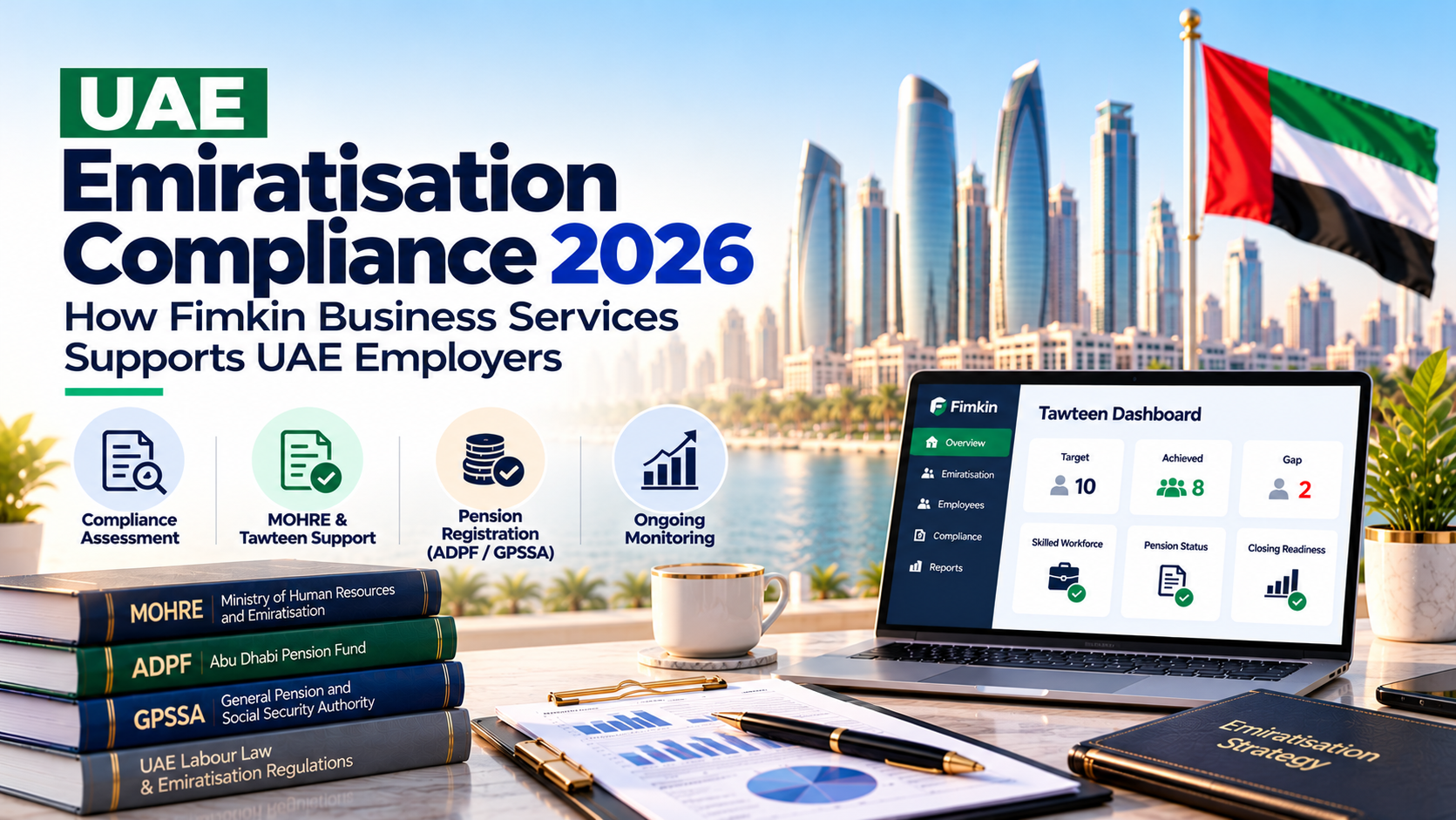
Our proposed managed compliance approach follows three stages: Diagnose, Execute and Monitor.
Stage 1: Diagnose — Emiratisation Compliance Review
We begin by reviewing the establishment's current Emiratisation position.
This may include:
- Reviewing the official MOHRE Emiratisation target.
- Checking the recognised Emirati employee headcount.
- Reviewing skilled workforce records and employee classifications.
- Identifying potential gaps between HR records and official government systems.
- Checking relevant ADPF or GPSSA pension registration status.
- Identifying possible compliance exposure and outstanding administrative requirements.
This initial Emiratisation compliance assessment helps employers understand their current position before corrective action is planned.
Stage 2: Execute — MOHRE, Tawteen and Pension Registration Support
After identifying the relevant requirements, Fimkin coordinates agreed administrative procedures.
Our MOHRE and PRO services may include:
- Emirati employee onboarding documentation.
- MOHRE work permit and employment contract coordination.
- Tawteen-related administrative assistance.
- ADPF and GPSSA pension registration coordination.
- Nafis application guidance.
- Emirati employee cancellation and pension end-of-service documentation.
- Follow-up on outstanding government transactions.
Where an authority decision, eligibility assessment or specialist confirmation is required, the relevant issue is identified for follow-up.
Stage 3: Monitor — Monthly Emiratisation Compliance Tracking
Emiratisation should be monitored throughout the year rather than only before official assessment deadlines.
Fimkin's proposed monthly Emiratisation compliance monitoring service helps employers maintain an organised compliance tracker and review outstanding administrative matters.
The monitoring process can cover:
Compliance areaMonitoring activityEmiratisation targetReview the applicable official MOHRE requirementRecognised Emirati employeesCompare official headcount with HR recordsWorkforce classificationIdentify discrepancies requiring reviewPension complianceTrack relevant ADPF and GPSSA registration mattersEmployee departuresIdentify exits that may affect the recognised targetCompliance readinessReview outstanding actions before assessment deadlines
This approach can support more effective workforce planning and reduce avoidable administrative delays.
Why Choose a Coordinated Emiratisation Compliance Service?
A connected compliance process can help employers:
- Identify potential Emiratisation shortfalls earlier.
- Reduce avoidable delays in MOHRE and pension-related procedures.
- Improve visibility over employee records and registration status.
- Monitor resignations and terminations that may affect compliance.
- Prepare for the June and December Emiratisation assessment checkpoints.
- Maintain organised documentation for internal and official reviews.
- Coordinate HR, payroll and PRO responsibilities more efficiently.
Fimkin's role is to coordinate the relevant PRO and compliance processes within the agreed scope.
Final Emiratisation targets, employee recognition, pension eligibility, statutory entitlements and regulatory assessments remain subject to the relevant government authorities.
Preparing for the December 2026 Emiratisation Deadline
For covered private-sector establishments, 31 December 2026 is an important Emiratisation assessment checkpoint.
Employers should review their official targets, recognised Emirati workforce and outstanding compliance requirements before the deadline.
Planning should begin with an official MOHRE target review—not an assumption about how many Emirati employees the company needs.
Businesses in Abu Dhabi, Dubai and other emirates can benefit from an establishment-level review to identify the administrative actions relevant to their circumstances.
Need Emiratisation Compliance Assistance in Abu Dhabi or Across the UAE?
Fimkin Business Services provides Emiratisation compliance support, MOHRE services, Emirati pension registration coordination and corporate PRO outsourcing for UAE businesses.
Whether your company needs assistance with Emirati employee onboarding, pension documentation, employment cancellation or monthly compliance monitoring, our team can help coordinate the relevant procedures.
Request an Emiratisation Compliance Review
Website: https://www.fimkinonline.com/
WhatsApp: +971 58 568 5569
Email: info@fimkin.com
Services are subject to the agreed scope, applicable authorisations and relevant government requirements.
Conclusion: Make Emiratisation an Ongoing Business Process
UAE Emiratisation compliance is easier to manage when it is treated as a continuous business responsibility rather than a last-minute recruitment exercise.
The first step is to establish the company's official MOHRE target. The next is to confirm that its Emirati employees are correctly employed, paid, registered under the applicable pension system and recognised for the relevant requirement.
Regular Emiratisation compliance monitoring helps employers identify potential gaps, manage employee departures, maintain accurate records and prepare for upcoming assessment deadlines.
As the UAE continues to develop its private-sector workforce, businesses that invest in structured HR and compliance processes will be better positioned to manage their obligations and plan workforce requirements.
The most important question is not simply whether your company has hired Emirati employees. It is whether your company can demonstrate that it is meeting its applicable Emiratisation requirements.
Frequently Asked Questions About UAE Emiratisation Compliance in 2026
1. What are the UAE Emiratisation rules for 2026?
Covered private-sector establishments with 50 or more employees must meet the applicable skilled-job Emiratisation growth targets, including the relevant first-half and year-end requirements. Selected establishments with 20–49 employees are subject to separate requirements based on designated economic activities. Employers should verify their exact obligations through MOHRE.
2. Is Emiratisation mandatory for companies with 20–49 employees?
It can be mandatory for establishments operating in designated economic activities and covered by the applicable requirements. The rules introduced targets of one Emirati employee in 2024 and an additional Emirati employee in 2025. Employers should check their current obligations and outstanding requirements through official MOHRE records.
3. How many Emirati employees must a company with 50 employees hire?
There is no single hiring number that can safely be applied to every establishment. The requirement depends on the official Emiratisation target, skilled workforce base and applicable calculation methodology.
4. What is the Emiratisation penalty in the UAE for 2026?
For covered establishments with 50 or more employees, the published contribution schedule reaches AED 10,000 per month for each missing required Emirati employee in 2026, equivalent to AED 120,000 over 12 months per missing position. Actual assessments depend on the applicable rules and period.
Different contribution arrangements apply to selected establishments with 20–49 employees.
5. Is the June 2026 Emiratisation deadline over?
Yes. The first-half checkpoint was 30 June 2026. Covered employers should review their current compliance position and prepare for the 31 December 2026 checkpoint.
6. Does hiring an Emirati employee automatically satisfy Emiratisation requirements?
Not necessarily. The employment must satisfy the applicable conditions, and the employee must be recognised for the relevant target. Employers should verify the work permit, employment contract, classification, payroll and pension registration where applicable.
7. What is the difference between MOHRE and Nafis?
MOHRE administers relevant labour processes and Emiratisation requirements for covered establishments. Nafis provides eligible UAE nationals with employment-related programmes and incentives. Nafis benefits do not replace the employer's contractual salary or statutory obligations.
8. What are the pension contribution rates for Emirati employees?
Rates depend on the applicable pension authority, legislation and employee circumstances. Certain qualifying new entrants may fall under an 11% employee and 15% employer contribution structure. Employers should verify the applicable pensionable salary and contribution requirements.
9. What happens if an Emirati employee resigns?
The employer should complete the relevant employment cancellation, final settlement and pension procedures, then reassess its recognised Emirati headcount and any applicable replacement requirements.
10. Can an employer use the expatriate gratuity formula for an Emirati employee?
Not automatically. For insured UAE nationals, the applicable pension legislation, recognised service, pensionable salary and individual circumstances determine the relevant entitlements.
11. Can a PRO service provider assist with Emiratisation compliance?
Yes. A PRO service provider can coordinate relevant employment documentation, government transactions, pension registration support, cancellation procedures and compliance tracking within its agreed scope and authorisations.
12. How can a company check its Emiratisation compliance status?
Employers should review their official MOHRE targets and recognised Emirati headcount, compare them with internal HR records, verify relevant employment and pension information, and investigate discrepancies through the appropriate official channels.
13. Why should companies review Emiratisation compliance monthly?
Monthly reviews can help employers identify changes in headcount, unrecognised employees, incomplete pension transactions and departures that could affect their targets.
14. Does Emiratisation apply to every UAE company?
No single Emiratisation requirement applies identically to every establishment. Obligations depend on factors including jurisdiction, workforce size, economic activity and official regulatory classification.
15. Does Fimkin provide monthly Emiratisation compliance support?
Fimkin offers corporate PRO and Emiratisation-related administrative assistance. Monthly compliance monitoring and outsourcing arrangements can be discussed according to the company's workforce size and agreed service scope.
16. How can a company prepare for the December 2026 Emiratisation deadline?
Employers should verify their official MOHRE targets, review recognised Emirati employees, check pension and payroll records, investigate compliance gaps and complete relevant administrative actions before the assessment deadline.
Official sources
- Ministry of Human Resources and Emiratisation: https://www.mohre.gov.ae
- Abu Dhabi Pension Fund: https://www.adpf.gov.ae
- General Pension and Social Security Authority: https://www.pension.gov.ae
- Nafis: https://nafis.gov.ae
Disclaimer: This article is for general information and business planning purposes and does not constitute legal advice. Emiratisation requirements, financial contributions, pension rules and benefit eligibility may change or vary according to individual circumstances. Employers should confirm their current position with the relevant authorities.