
UAE Emiratisation rules 2026
Emiratization Targets in 2026: How Should Employers Calculate Their Requirement?
Complete guide to UAE Emiratization rules 2026. Learn MOHRE hiring targets, penalties, Nafis benefits, ADPF and GPSSA pension requirements, and employer compliance.
Understanding the UAE Emiratization targets for 2026 is essential for employers planning their workforce and managing MOHRE compliance requirements.
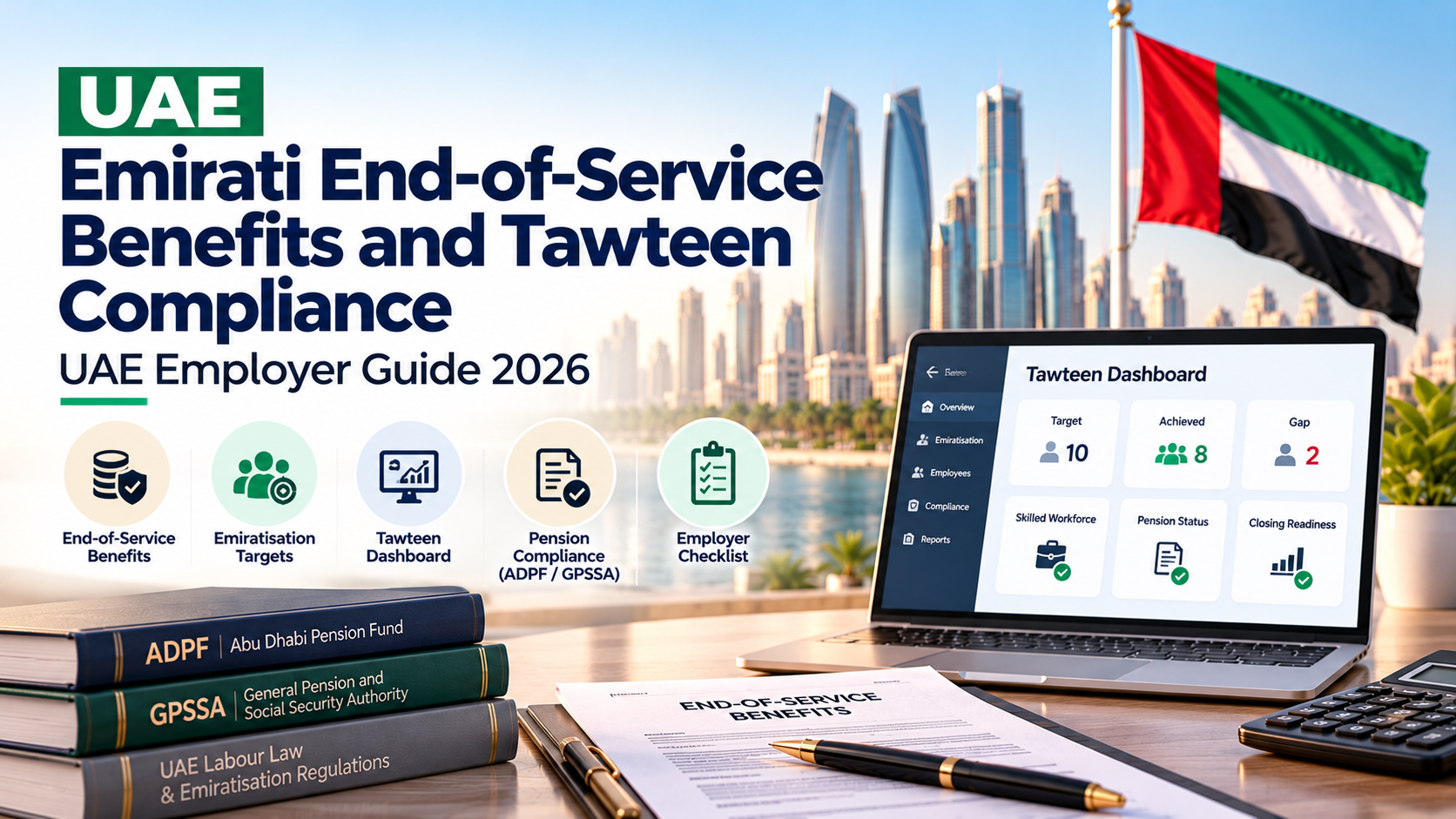
Consider a hypothetical company with 80 skilled employees.
Management wants to understand its Emiratization obligation for December 2026. A simple illustrative calculation would be:
Item
Example
Skilled workforce
80 employees
Illustrative cumulative target
10%
Illustrative number of Emirati employees
8 employees
In this example, 10% of 80 is eight employees.
However, this is an illustration, not an official quota determination.
The actual obligation may depend on MOHRE's calculation methodology, the establishment's recognised skilled workforce, the relevant assessment period, rounding rules and the target displayed in the official system.
Employers should not assume that multiplying the current number of employees by 10% will always produce the correct legal requirement.
The Six Questions Every Employer Should Ask
Before making an Emirati recruitment decision, confirm:
- Is the establishment covered by the applicable Emiratization rules?
- What is its official Emiratization target in the MOHRE system?
- What workforce base is used to calculate that target?
- How many Emirati employees are currently recognized?
- Are there any outstanding employment, payroll or pension issues?
- What action is required before the next assessment date?
Answering these questions provides a much more reliable starting point than estimating the quota internally.
What Are the Emiratization Penalties in 2026?
Financial exposure is one of the strongest reasons for employers to manage Emiratization compliance in the UAE proactively.
For establishments with 50 or more employees that are subject to the relevant skilled-job targets, the financial contribution for non-compliance has increased over the years.
The 2026 rate presented in Fimkin's Emiratization advisory briefing is AED 10,000 per month for each missing required Emirati employee, equivalent to AED 120,000 annualized for one missing position at that rate.
The actual assessment depends on the applicable period, the number of missing positions and the establishment's official compliance position.
Example: What Could One Missing Emirati Position Cost?
Suppose an establishment is assessed as having one missing required Emirati position at the stated 2026 rate.
Calculation
Amount
Monthly contribution
AED 10,000
Annualized amount
AED 120,000
If the establishment has more than one missing position, the financial exposure may increase accordingly.
This is why employers should not wait until the end of the year to investigate an Emiratization shortfall.
The relevant rules for companies with 20–49 employees must be considered separately, as the contribution structure for that category differs from the monthly per-position calculation applicable to larger establishments.
A practical note for 2026: The 30 June checkpoint has passed. Businesses covered by the first-half requirement should review their compliance position immediately and prepare for the 31 December checkpoint.
The current Emiratization status should be verified through MOHRE rather than inferred from an internal headcount report.
Is Hiring an Emirati Employee Enough to Meet the Requirement?
This is one of the most important questions for UAE employers.
Recruiting a UAE national is an essential step, but a signed offer letter or issued work permit alone should not be treated as proof that the employee has been recognized for Emiratization purposes.
The employer must ensure that the employment arrangement and supporting records satisfy the applicable MOHRE Emiratization requirements.
A practical compliance process involves five stages.
Stage 1: Recruit for a Genuine Position
The role should reflect a real business requirement, with appropriate responsibilities and working arrangements.
Employers should avoid treating Emiratization as a paperwork exercise. The objective is genuine employment and meaningful participation in the workforce.
Stage 2: Complete the Employment Formalities
The employer should ensure that the necessary work permit, employment contract and related records are processed correctly.
Job classification and the nature of the role should also be reviewed where relevant to the skilled-job requirement.
Stage 3: Maintain Accurate Payroll Records
Salary payments should reflect the actual employment arrangement and comply with applicable UAE employment and payroll requirements.
Payroll evidence is an important part of the employer's Emiratization compliance records.
Stage 4: Complete the Applicable Pension Registration
Emirati employee pension registration is an important part of employment compliance.
The employee's pension arrangements should be assessed under the correct system.
Depending on eligibility and applicable legislation, the employer may need to coordinate with the Abu Dhabi Pension Fund (ADPF) or the General Pension and Social Security Authority (GPSSA).
The employer should confirm the applicable pension authority, registration status, contribution requirements and payment records.
Stage 5: Verify Recognition in the Official MOHRE System
The final step is to check whether the employee is recognized for the relevant Emiratization target.
If the employee has been hired but is not recognized, the employer should investigate the reason and resolve the outstanding issue.
This may involve reviewing the employment permit, contract, job classification, wage records, pension registration or employee status.
The key principle is simple: recruitment, employment documentation, payroll, pension and official MOHRE recognition must work together.
Is Your Company Meeting Its UAE Emiratization Requirements for 2026?
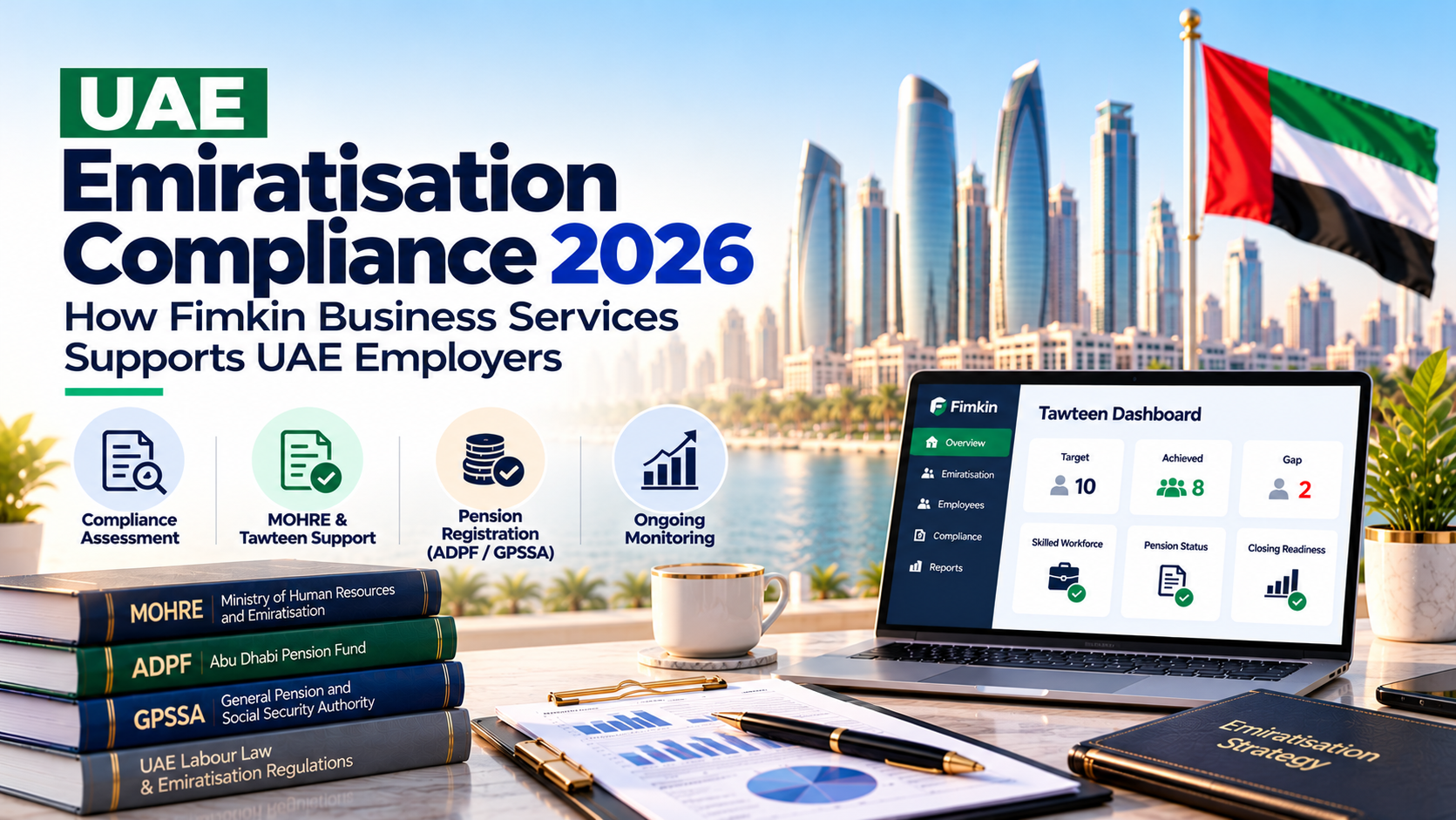
Fimkin Business Services assists employers with Emiratization compliance reviews, MOHRE documentation, Emirati employee onboarding, pension registration coordination and ongoing corporate PRO support.
Request Your Emiratization Compliance Review Today!
📞 +971 58 568 5569