foodstuff trading company Abu Dhabi
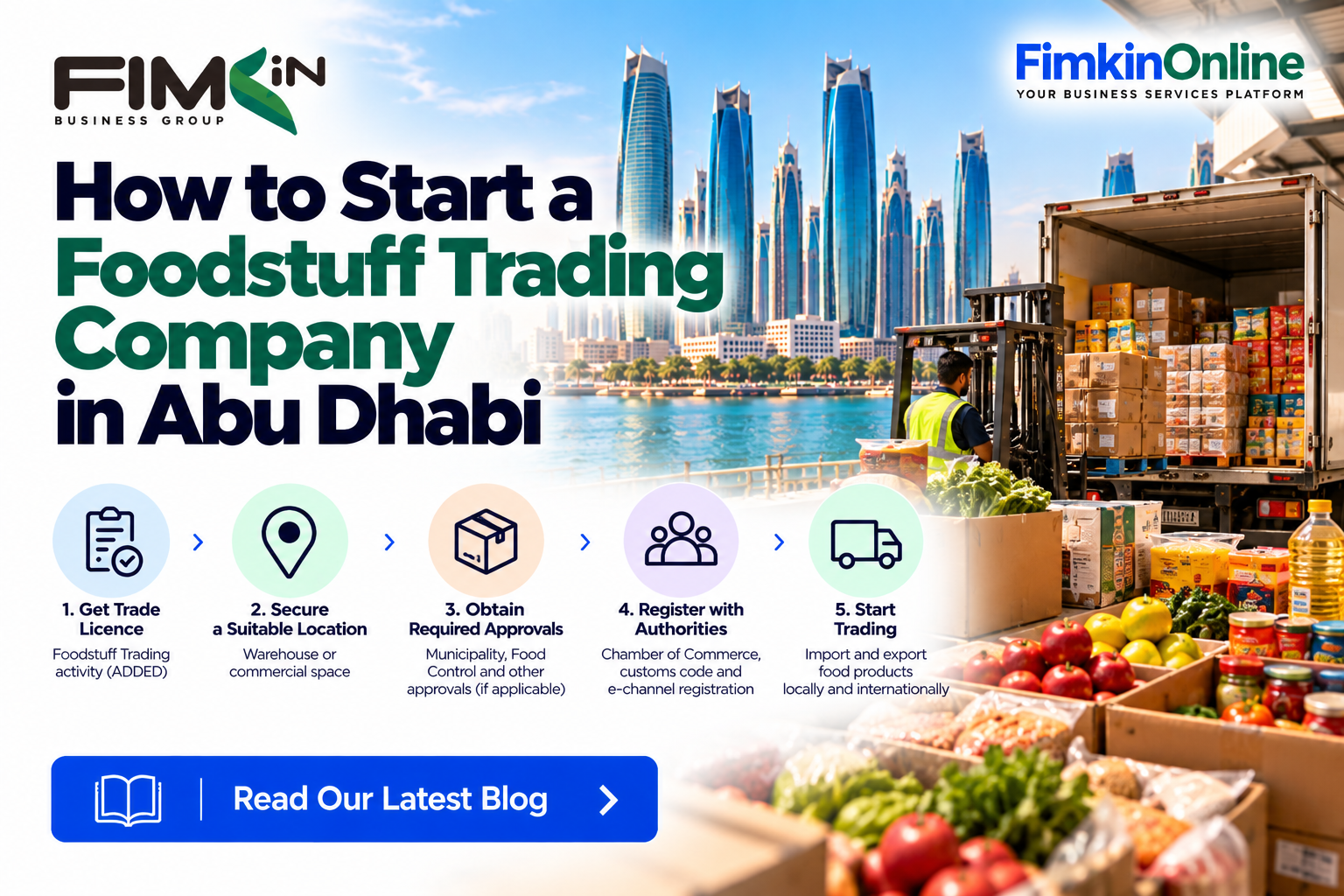
How to Start a Foodstuff Trading Company in Abu Dhabi
Learn how to start a foodstuff trading company in Abu Dhabi. Explore trade licence requirements, ADAFSA approvals, warehouse setup, import permits and costs with FimkinOnline.
Abu Dhabi offers opportunities for entrepreneurs involved in the import, wholesale, distribution and retail of food products. A foodstuff trading company can supply supermarkets, grocery stores, restaurants, hotels, catering businesses and other food-service operators with products sourced locally or from international markets.
However, food trading is different from ordinary commercial trading because food products are subject to additional safety, labelling, storage and handling requirements. In Abu Dhabi, food businesses are regulated across the food chain, including food imports, transportation, distribution and sale.
If you are planning to start a foodstuff trading company in Abu Dhabi, the following steps can help you understand the process.
1. Decide Which Food Products You Want to Trade
Start by defining the exact food categories your company will handle.
A foodstuff trading company may deal in:
● Rice, flour and grains
● Pulses and cereals
● Sugar and other grocery products
● Cooking oils
● Spices and seasonings
● Canned and packaged foods
● Frozen foods
● Dairy products
● Beverages
● Confectionery
● Snacks
● Meat and poultry products
● Fruits and vegetables
● Organic or specialty foods
The product range matters because different food categories can have different storage, labelling, transportation and regulatory requirements.
For example, frozen products require appropriate temperature-controlled storage and transportation, while dry grocery products have different storage requirements.
2. Select the Appropriate Business Activity
The first formal step in establishing a business in Abu Dhabi is determining the nature of the business activity. ADDED states that the business activity determines the type of economic licence required, and businesses must fulfil the applicable terms and conditions for their selected activity.
For a foodstuff trading company, the activity should accurately reflect the food products and trading operations the company intends to conduct.
If the company plans to undertake additional activities such as food processing, manufacturing, catering or restaurant operations, these should be considered separately rather than assuming they are automatically covered by a foodstuff trading activity.
3. Choose the Legal Structure
The entrepreneur then needs to select a legal form suitable for the proposed business.
ADDED's business setup process allows investors to select a legal form according to their business activity and ownership structure. Available structures include limited liability companies, partnerships and other permitted forms.
The choice can depend on:
● Number of shareholders
● Ownership arrangement
● Business activity
● Investment plans
● Visa requirements
● Future expansion
Choosing the appropriate legal structure at the beginning can make future changes easier to manage.
4. Reserve a Trade Name
The company needs a suitable trade name that complies with Abu Dhabi's naming requirements.
ADDED identifies trade-name reservation as one of the primary licensing services available to investors and businesses.
The name should be appropriate for the company's business and should not conflict with an existing registered name.
5. Obtain Initial Approval
After determining the business activity, legal form and trade name, the entrepreneur can proceed with the initial approval process.
ADDED's current business setup process identifies initial approval as one of the steps before completing the final business licence. Depending on the activity and ownership structure, contractual documents such as an MOA may also be required.
6. Obtain the Abu Dhabi Economic Licence
A foodstuff trading business needs the appropriate economic licence before beginning commercial operations.
ADDED describes an economic licence as authorisation to practise a specific economic activity after fulfilling the applicable legal requirements. Its standard economic licence permits businesses to operate in Abu Dhabi and accommodates different legal forms.
The final licensing requirements depend on the selected activity, legal form, premises and any additional approvals required.
7. Arrange Suitable Premises and Storage
Foodstuff trading companies need premises suitable for receiving, storing and distributing food products.
Depending on the business model, this could include:
● Office space
● Retail premises
● Dry-storage warehouse
● Refrigerated storage
● Frozen storage
● Loading and unloading areas
● Distribution facilities
The storage conditions should match the products being handled. Perishable and temperature-sensitive foods require appropriate temperature control and food-safety procedures.
ADAFSA's food-safety guidance covers requirements relating to food receiving, storage and temperature control, demonstrating why premises should be planned around the type of food being traded.
8. Meet Abu Dhabi Food-Safety Requirements
This is one of the most important differences between foodstuff trading and ordinary goods trading.
Food business operators are responsible for ensuring that food placed on the Abu Dhabi market is safe, wholesome and properly labelled. ADAFSA's food-labelling guidance applies to food produced domestically as well as food imported from other emirates and countries.
Businesses should therefore consider:
● Food safety
● Proper storage
● Temperature control
● Food handling
● Traceability
● Product documentation
● Labelling
● Expiry dates
● Packaging
● Recall procedures
The exact requirements depend on the type of food and the company's activities.
9. Check Food Labelling Requirements
Food labels are particularly important when importing packaged food into Abu Dhabi.
ADAFSA states that pre-packaged food placed on the Abu Dhabi market must contain the required information and that labels should be clear and not misleading to consumers. The requirements also apply to imported food products.
Before importing products, businesses should check matters such as:
● Product name
● Ingredients
● Allergen information where applicable
● Net quantity
● Country of origin
● Production information
● Expiry or best-before information
● Storage conditions
● Manufacturer/importer information
Specific food categories can have additional labelling requirements, so the requirements should be checked for each product.
10. Arrange Food Import and Customs Procedures
If the company imports food from outside the UAE, customs and food-control procedures need to be considered together.
The company should maintain appropriate documentation for shipments, including:
● Commercial invoices
● Packing lists
● Shipping documents
● Product details
● Certificates required for the relevant products
● Import documentation
● Customs declarations
Food importers should also make sure that their products meet the applicable UAE and Abu Dhabi food-safety requirements before arranging large shipments.
This is especially important for perishable products because delays during clearance can affect shelf life and product quality.
11. Choose Reliable Food Suppliers
A foodstuff trading company depends heavily on reliable suppliers.
Before entering into long-term supply agreements, verify:
● Supplier credentials
● Product quality
● Country of origin
● Ingredients
● Shelf life
● Packaging
● Storage requirements
● Certificates and documentation
● Minimum order quantities
● Delivery arrangements
For imported food, the company should also establish clear procedures for handling damaged, expired or non-conforming products.
12. Establish Proper Warehousing and Distribution
Food trading requires more than simply having a place to store products.
The company should establish systems for:
● Receiving goods
● Checking product condition
● Monitoring expiry dates
● Maintaining appropriate temperatures
● Separating different product categories
● Managing stock rotation
● Preparing orders
● Delivering products safely
A first-expiry-first-out (FEFO) approach can be useful for products with limited shelf lives, helping businesses reduce unnecessary food waste.
13. Build a Distribution Network
Once products are imported or sourced, the company needs an efficient way to distribute them.
Potential customers can include:
● Supermarkets
● Grocery stores
● Restaurants
● Hotels
● Catering companies
● Cafeterias
● Food wholesalers
● Other retailers
The distribution model should consider delivery routes, vehicle requirements, storage temperatures and the shelf life of products.
For chilled or frozen food, transportation must be suitable for maintaining the required conditions throughout delivery.
14. Open a Corporate Bank Account
After the company is established, a corporate bank account can be used for supplier payments, customer receipts and operating expenses.
Banks may request information about:
● Company activities
● Shareholders
● Expected turnover
● Suppliers
● Customers
● Countries involved in imports and exports
● Source of funds
For an international food trading company, maintaining clear supplier and customer documentation can help demonstrate the expected business activity.
15. Understand VAT and Corporate Tax
Tax compliance should be considered from the beginning.
For UAE-resident businesses, VAT registration becomes mandatory when taxable supplies and imports exceed AED 375,000 over the previous 12 months or are expected to exceed that amount within the next 30 days. Voluntary registration is available above AED 187,500, subject to the applicable rules.
Corporate Tax registration and compliance should also be assessed according to the company's circumstances. The FTA states that taxable persons are required to register for UAE Corporate Tax according to the applicable legislation and implementing decisions.
The company should maintain proper records of:
● Sales
● Purchases
● Import transactions
● Customs documents
● VAT invoices
● Operating expenses
● Inventory
● Supplier payments
16. Estimate the Startup Cost
There is no single fixed cost for establishing a foodstuff trading company in Abu Dhabi.
The total investment can depend on:
● Economic licence
● Business activity
● Legal structure
● Office or warehouse
● Food-storage facilities
● Refrigeration or freezing equipment
● Visas
● Food-related approvals
● Customs and import expenses
● Initial inventory
● Delivery vehicles
● Staff
● Accounting and compliance
For foodstuff trading, working capital and storage requirements can represent a significant part of the initial investment, particularly when dealing with imported or perishable products.
How Fimkin Can Help?
Fimkin Business Setup Services can assist entrepreneurs with the company formation process, including understanding the appropriate business structure, preparing documentation and completing the relevant setup procedures.
For a foodstuff trading business, getting the business activity, premises and food-related compliance requirements right at the beginning can make importing, storing and distributing products much easier to manage.
Launch your business in abudhabi:https://www.fimkinonline.com/services/58e1b473-7dfe-4b36-8d9f-c41d249d2d08
Conclusion
Starting a foodstuff trading company in Abu Dhabi requires careful planning because the business must satisfy both commercial licensing requirements and food-safety requirements.
Entrepreneurs should begin by deciding which food products they intend to trade, selecting the appropriate economic activity and legal structure, reserving a trade name and obtaining the required Abu Dhabi economic licence. They should then arrange suitable premises, establish proper food-storage systems and address the applicable food labelling, import, customs and safety requirements.
A well-planned supply chain is equally important. Reliable suppliers, appropriate warehouses, temperature-controlled facilities where necessary and an efficient distribution network can help the business maintain product quality and serve customers effectively.
With the right licensing structure and food-safety systems in place, a foodstuff trading company can serve supermarkets, retailers, restaurants, hotels, caterers and other businesses across Abu Dhabi and beyond.
Frequently asked questions (FAQs)
1. Can foreigners start a foodstuff trading company in Abu Dhabi?
Yes. Foreign investors can establish businesses in Abu Dhabi, subject to the ownership, activity and legal requirements applicable to the selected business structure.
2. Which licence is required for foodstuff trading?
A suitable Abu Dhabi economic licence covering the relevant food trading activity is required. The exact activity should match the products and operations of the company.
3. Can I import food products into Abu Dhabi?
Yes, but imported food must comply with applicable customs and food-safety requirements.
4. Does foodstuff trading require additional approvals?
Depending on the activity and products involved, additional requirements or approvals may apply. ADDED states that additional approvals can be required depending on the business activity and location.
5. Do imported food products need proper labelling?
Yes. ADAFSA's food-labelling guidance applies to food placed on the Abu Dhabi market, including food imported from other emirates and countries.
6. Do I need a warehouse for foodstuff trading?
The premises required depend on the business model and products. Businesses dealing with significant quantities or perishable products may require appropriate warehouse and temperature-controlled storage facilities.
7. Can I trade both local and imported food products?
Yes, provided the company's activities and applicable food-safety and regulatory requirements cover the intended operations.
8. Is VAT registration mandatory?
VAT registration is mandatory for a UAE-resident business when taxable supplies and imports exceed the AED 375,000 mandatory threshold, subject to the applicable rules.
9. Can I sell foodstuff to supermarkets and restaurants?
Yes. A foodstuff trading company can supply businesses such as supermarkets, grocery stores, restaurants and catering operators, subject to the applicable licensing and food-safety requirements.
10. Can Fimkin help with foodstuff trading company formation?
Yes. Fimkin can assist entrepreneurs with the company formation process and help them understand the relevant licensing and setup requirements for their planned foodstuff trading business.