industrial company Abu Dhabi
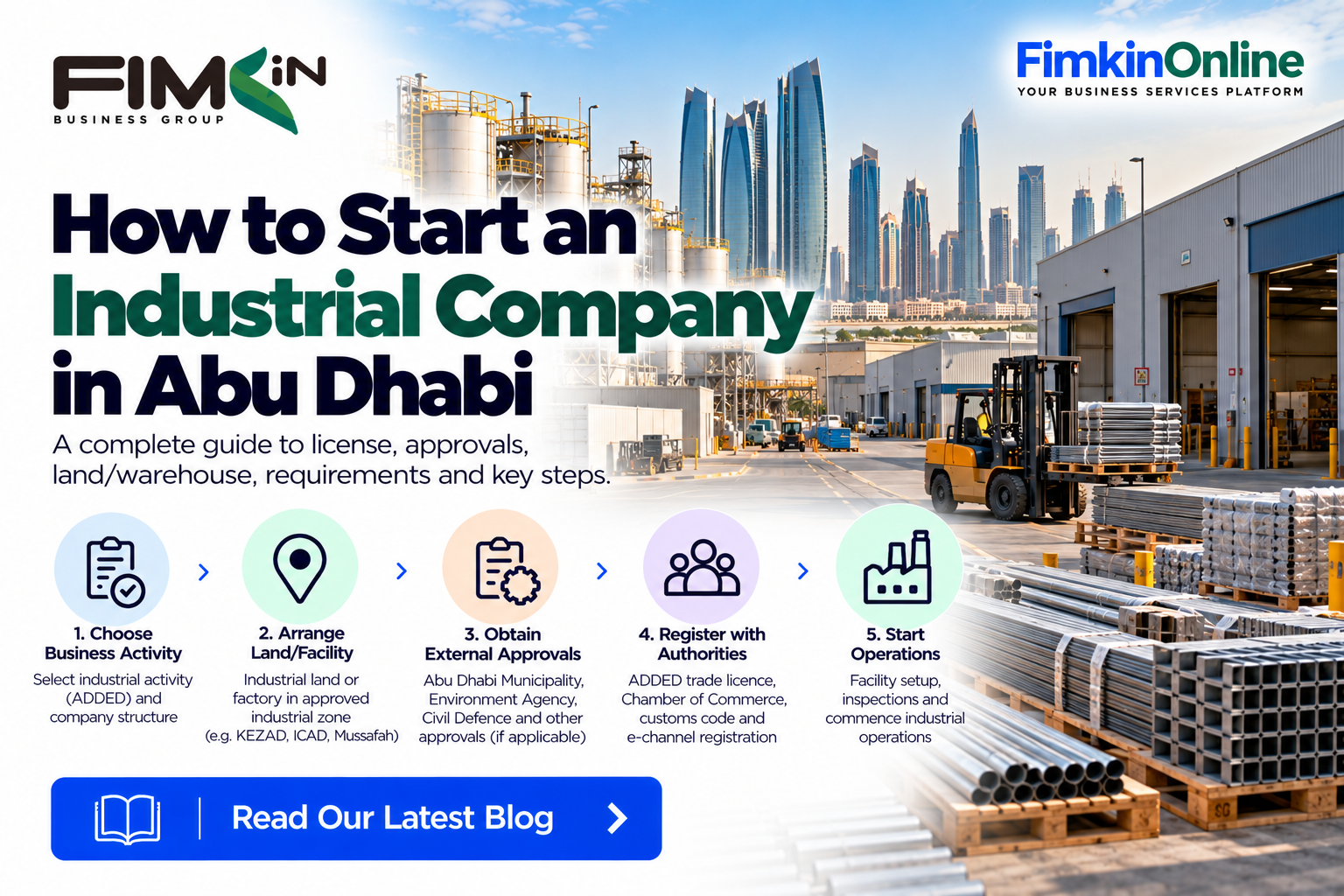
How to Start an Industrial Company in Abu Dhabi
Learn how to start an industrial company in Abu Dhabi. Explore industrial licensing, KEZAD and ICAD locations, factory approvals, setup costs and key requirements with FimkinOnline.
Abu Dhabi has a growing industrial and manufacturing sector, supported by industrial zones, infrastructure, investment programmes and access to regional and international markets. Entrepreneurs can establish industrial businesses involved in manufacturing, processing, assembly, fabrication, packaging and other production activities.
However, starting an industrial company is different from setting up an ordinary trading or service business. The entrepreneur needs to select the correct industrial activity, obtain the appropriate industrial licence, identify a suitable industrial location, plan the facility and equipment, and obtain any additional environmental, safety or technical approvals required for the project. Abu Dhabi's official business setup process specifically identifies industrial as one of its main licence categories.
Here is a practical guide to starting an industrial company in Abu Dhabi.
1. Decide What You Want to Manufacture
The first step is to clearly define the industrial activity and products.
Abu Dhabi's Industrial Development Bureau (IDB) covers a wide range of manufacturing sectors, including:
● Food manufacturing
● Chemical industries
● Pharmaceutical manufacturing
● Machinery and equipment
● Electrical and electronics manufacturing
● Transportation manufacturing
● Plastics and rubber
● Metal products
● Wood and paper products
● Textiles and leather
● General industries
The specific industrial activity is important because licensing, facility and regulatory requirements can vary depending on the type of production. IDB maintains activity lists for different manufacturing sectors.
2. Select the Appropriate Industrial Activity
Before applying for a licence, determine the exact economic activity the company will conduct.
For example, manufacturing furniture, food products, chemicals, machinery or electronic equipment can involve very different technical and regulatory requirements.
The activity should accurately describe the company's actual production process. If you intend to manufacture several types of products, check whether additional activities need to be added to the licence.
ADDED states that determining the business activity is the first step in establishing a legally recognised business in Abu Dhabi, with industrial licensing available for industrial activities.
3. Choose the Legal Structure
The next step is to select a suitable legal form for the company.
Depending on the ownership and business requirements, options can include an LLC and other permitted legal structures.
ADDED states that investors must select a legal form that suits the business activity and ownership, with structures including limited liability companies, partnerships and public joint stock companies among the available forms.
The legal structure should be considered carefully because it can affect ownership arrangements, documentation and future expansion.
4. Choose an Industrial Location
An industrial company requires a suitable physical location for its production activities.
Depending on the business, the facility may need space for:
● Production machinery
● Raw-material storage
● Finished-goods storage
● Loading and unloading
● Offices
● Worker facilities
● Waste management
● Utilities
● Safety systems
The selected premises must comply with the requirements applicable to the industrial activity.
Abu Dhabi's official setup process requires businesses that need physical premises to identify a suitable location and obtain a tenancy contract.
5. Reserve the Trade Name
The company then needs to choose and register an appropriate trade name.
The name should comply with Abu Dhabi's applicable naming requirements and should not conflict with an existing registered business.
ADDED lists trade-name reservation as one of its primary economic licensing services.
6. Obtain Initial Approval and the Industrial Licence
After determining the activity, legal form, trade name and location, the company can proceed through the applicable licensing process.
ADDED's current process includes:
● Selecting the business activity
● Selecting the legal form
● Reserving the trade name
● Obtaining initial approval
● Completing required contractual documents
● Arranging the business location
● Obtaining additional approvals where required
● Receiving the final business licence
An industrial company therefore needs the appropriate industrial licence, rather than simply a general commercial trading licence.
7. Plan the Factory and Production Facility
The physical factory should be planned around the selected manufacturing activity.
This can include:
● Production lines
● Machinery
● Electrical systems
● Ventilation
● Fire-safety systems
● Raw-material storage
● Finished-product storage
● Worker areas
● Waste-management facilities
● Quality-control areas
The design requirements will depend heavily on the industry.
For example, a food manufacturing facility will have very different requirements from a metal fabrication plant or chemical manufacturing facility.
8. Obtain Environmental and Other Approvals
Industrial businesses may require additional approvals beyond the economic licence.
Environmental permitting is particularly important for industrial facilities. Abu Dhabi's environmental-permit guidance states that industrial and commercial facilities may require environmental permits for different stages of the facility, including construction, operation and decommissioning.
The approvals required can depend on:
● Type of manufacturing
● Location
● Production processes
● Machinery
● Waste generated
● Emissions
● Chemicals used
● Environmental impact
Therefore, environmental and technical requirements should be assessed before beginning construction or installing major equipment.
9. Obtain the Required Construction and Facility Approvals
If the business is building a new factory or modifying an industrial facility, additional approvals may be necessary before construction and operation.
The company may need to coordinate requirements relating to:
● Building and site plans
● Industrial facility design
● Fire and life safety
● Environmental protection
● Utilities
● Occupational health and safety
● Waste management
The exact approvals depend on the project and its location.
10. Install Machinery and Production Equipment
Once the facility requirements are established, the company can plan its machinery and production equipment.
The equipment will depend on the manufacturing process and could include:
● Production machinery
● Assembly lines
● Industrial ovens
● CNC equipment
● Packaging machinery
● Mixing equipment
● Testing equipment
● Storage systems
● Material-handling equipment
Entrepreneurs should also budget for installation, maintenance, spare parts, energy consumption and employee training.
11. Plan Raw-Material Supply
A manufacturing company needs a reliable supply chain for raw materials.
Depending on the industry, materials may be sourced locally or imported.
The business should evaluate:
● Supplier reliability
● Material quality
● Pricing
● Minimum order quantities
● Delivery times
● Import requirements
● Storage requirements
● Alternative suppliers
Maintaining more than one reliable supplier can also help reduce disruption to production.
12. Establish Quality-Control Procedures
Quality control is essential for an industrial company.
The business should establish procedures for checking:
● Incoming raw materials
● Production processes
● Finished products
● Product specifications
● Packaging
● Defective products
Certain industries may also require specific technical standards, testing or certification before products can be placed on the market.
The exact standards depend on the industrial activity and products manufactured.
13. Recruit Skilled Employees
Industrial companies may require employees with specialised technical skills.
Depending on the factory, this can include:
● Production workers
● Engineers
● Machine operators
● Quality-control staff
● Maintenance technicians
● Warehouse workers
● Health and safety personnel
● Supervisors
The company should also plan for applicable employment, workplace safety and worker accommodation requirements.
14. Consider Abu Dhabi Industrial Incentives
Eligible industrial projects may be able to benefit from Abu Dhabi's industrial incentive programmes.
For example, the Industrial Development Bureau's Land Rebate Incentive Programme covers targeted sectors including electrical manufacturing, electronics manufacturing, chemical manufacturing, food processing, pharmaceuticals, machinery and equipment manufacturing, and transportation manufacturing. Eligibility conditions apply, including having the relevant industrial licence status and a valid Musataha contract with an eligible developer.
The availability and conditions of incentives should be checked according to the project's sector, location and licence status.
15. Arrange Financing and Working Capital
Industrial businesses generally require more capital than small trading or service companies because they may need to finance:
● Industrial land or premises
● Factory construction
● Machinery
● Raw materials
● Utilities
● Employee costs
● Logistics
● Testing and certification
● Inventory
● Working capital
A detailed financial plan should therefore be prepared before starting the project.
16. Open a Corporate Bank Account and Handle Tax Compliance
Once the company is established, a corporate bank account can be used for supplier payments, customer receipts, payroll and other operating expenses.
The company should also establish proper accounting systems from the beginning and assess its UAE VAT and Corporate Tax obligations according to its activities and financial position.
Maintaining accurate records of purchases, production costs, sales, inventory, imports and expenses is particularly important for manufacturing businesses.
17. Estimate the Cost of Starting an Industrial Company
There is no single fixed cost for setting up an industrial company in Abu Dhabi.
The investment can vary significantly depending on:
● Industrial activity
● Factory size
● Location
● Land or premises
● Industrial licence
● Construction
● Machinery
● Raw materials
● Utilities
● Environmental approvals
● Product certification
● Labour
● Warehousing
● Logistics
● Working capital
For an industrial project, factory development and machinery can represent a much larger investment than the company licence itself.
How Fimkin Can Help?
Fimkin Business Setup Services can assist entrepreneurs with the company formation process, including understanding the appropriate business structure, preparing documentation and completing relevant setup procedures.
For an industrial company, getting the industrial activity, legal structure, location and approval requirements right at the beginning can make the later stages of developing and operating the facility much easier to manage.
Launch your business in abudhabi:https://www.fimkinonline.com/services/58e1b473-7dfe-4b36-8d9f-c41d249d2d08
Conclusion
Starting an industrial company in Abu Dhabi requires considerably more planning than setting up a simple trading or service business. Entrepreneurs need to define the manufacturing activity, choose the appropriate legal structure, obtain the industrial licence, secure a suitable location and plan the factory according to the requirements of the selected industry.
Environmental, safety, technical and product-related approvals should also be considered before construction and production begin. The Industrial Development Bureau provides sector-specific information and activity lists to help businesses understand the industrial opportunities and requirements in Abu Dhabi.
With careful planning, suitable facilities, reliable suppliers, qualified employees and proper compliance systems, an industrial company can establish a strong manufacturing operation in Abu Dhabi and potentially serve both the UAE and international markets.
Frequently asked questions (FAQs)
1. What licence is required to start an industrial company in Abu Dhabi?
An appropriate industrial economic licence is required for manufacturing and other qualifying industrial activities. ADDED identifies industrial licensing as one of the main licence categories in Abu Dhabi.
2. Can foreigners start an industrial company in Abu Dhabi?
Yes. Foreign investors can establish businesses in Abu Dhabi, subject to the ownership, activity and legal requirements applicable to the selected structure.
3. Do I need a factory to obtain an industrial licence?
Industrial businesses generally require an appropriate physical facility for their production activities. The premises and facility requirements depend on the specific industrial activity.
4. Are environmental approvals required?
Depending on the project and its activities, environmental permitting may be required. Abu Dhabi's environmental guidance covers industrial facilities at construction, operation and decommissioning stages.
5. Can I manufacture different products under one company?
Potentially, but the company must ensure that the relevant industrial activities are properly covered by its licence and that each product meets its applicable regulatory requirements.
6. What industries can be established in Abu Dhabi?
Abu Dhabi supports numerous manufacturing sectors, including food, chemicals, pharmaceuticals, machinery and equipment, electronics, transportation, plastics, textiles, wood and paper and general industries.
7. Are there incentives for industrial companies in Abu Dhabi?
Eligible projects may benefit from industrial incentive programmes. For example, IDB's Land Rebate Incentive Programme covers several targeted manufacturing sectors, subject to eligibility conditions.
8. How much does it cost to start an industrial company in Abu Dhabi?
There is no fixed cost. The total investment depends on the industrial activity, factory size, premises, machinery, approvals, workforce, raw materials and working capital.
9. Can an industrial company export products from Abu Dhabi?
Yes. An industrial company can plan production for both UAE and international markets, subject to applicable export, customs and product requirements.
10. Can Fimkin help with industrial company formation?
Yes. Fimkin can assist entrepreneurs with the company formation process and help them understand the licensing and setup requirements for their planned industrial business.