start manufacturing company Abu Dhabi
How to Start a Manufacturing Company in Abu Dhabi?
Learn how to start a manufacturing company in Abu Dhabi, including industrial licensing, approvals, facility requirements, permits and company registration.
Starting a manufacturing company in Abu Dhabi can be an attractive opportunity for entrepreneurs, investors, and international companies looking to establish production operations in the UAE. Abu Dhabi has developed a strong industrial ecosystem supported by industrial infrastructure, investment programmes, logistics networks, and initiatives designed to encourage manufacturing and industrial growth.
However, manufacturing is different from setting up an ordinary trading or service company. In addition to establishing the legal entity and obtaining the appropriate licence, a manufacturer may need industrial land or suitable premises, technical approvals, product and machinery information, environmental approvals, building permissions, and other requirements depending on the nature of production.
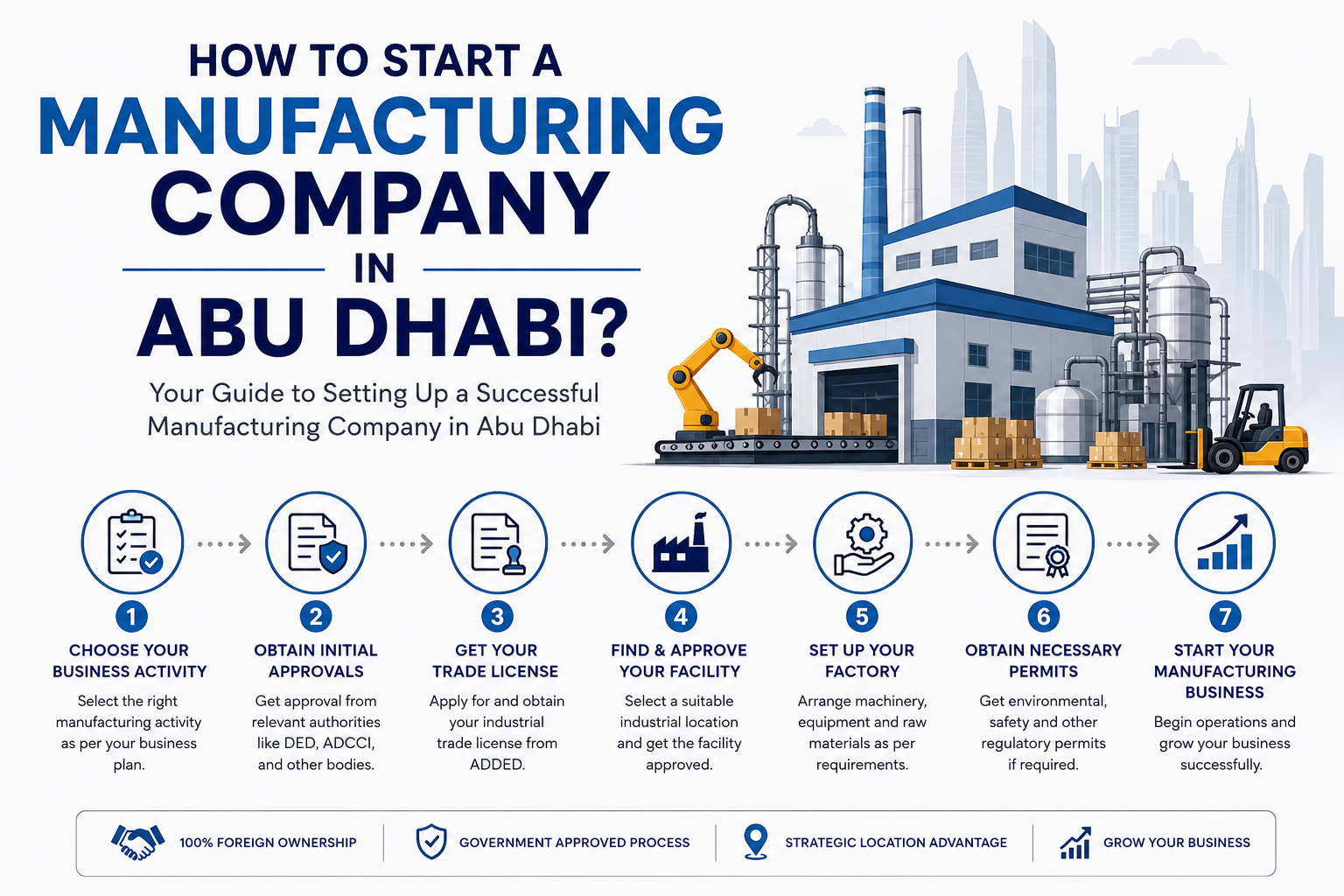
Abu Dhabi's business setup process begins with selecting the business activity, choosing the legal form, reserving a trade name, obtaining initial approval, arranging a suitable location, securing additional approvals where required, and obtaining the final licence. For manufacturing activities, the industrial licensing journey also involves the Abu Dhabi Industrial Development Bureau (IDB).
This guide explains the major steps involved in starting a manufacturing company in Abu Dhabi and the important requirements entrepreneurs should understand before investing.
Why Start a Manufacturing Company in Abu Dhabi?
Abu Dhabi has been actively developing its industrial sector as part of its broader economic diversification strategy. The Industrial Development Bureau identifies sectors such as food, metals, transportation, construction, machinery and equipment, and chemicals among Abu Dhabi's industrial sectors.
Manufacturing businesses can benefit from:
● Access to industrial infrastructure
● Strategic connections to regional and international markets
● Established logistics networks
● Availability of industrial land and facilities
● Government industrial support programmes
● Opportunities to supply local and international markets
● Potential customs-related incentives for qualifying industrial businesses
A growing ecosystem of industrial suppliers and service providers
For investors planning a long-term manufacturing operation, Abu Dhabi can therefore provide an environment for establishing production capacity and expanding into regional markets.
What Types of Manufacturing Businesses Can Be Started?
The appropriate industrial activity depends on what the company intends to manufacture.
Potential areas include:
● Food and beverage manufacturing
● Metal manufacturing
● Plastic and rubber products
● Construction materials
● Machinery and equipment
● Chemical products
● Packaging
● Industrial components
● Automotive-related products
● Consumer products
● Electrical and electronic products
● Building materials
The exact activity should be determined before beginning the licensing process because the selected industrial activity can affect premises, machinery, environmental requirements and external approvals.
Step 1: Determine Your Manufacturing Activity
The first and most important step is to define exactly what your factory will produce.
You should determine:
● The products to be manufactured
● Raw materials required
● Production capacity
● Manufacturing processes
● Machinery and equipment
● Number of employees
● Storage requirements
● Target market
● Expected imports and exports
Abu Dhabi's Industrial Development Bureau requires industrial investors to select the relevant industrial activity, while technical information concerning products and machinery becomes part of the industrial setup process.
Choosing the correct activity from the beginning can help prevent licensing complications later.
Step 2: Choose the Appropriate Business Structure
The next step is to choose the legal structure of the company.
Depending on the business model, possible structures may include:
● Limited Liability Company (LLC)
● Free-zone company
● Branch of a foreign company
● Other legally permitted corporate structures
The appropriate structure depends on factors such as ownership, investment plans, liability, location and intended operations.
Foreign investors should also verify the ownership rules applicable to their particular industrial activity and chosen jurisdiction.
Step 3: Reserve Your Trade Name
Once the business activity and structure have been decided, the company needs an appropriate trade name.
The name should comply with applicable UAE and Abu Dhabi requirements and should be available for registration.
For companies applying through the Industrial Development Bureau's establishment-stage process, reserving the trade name is one of the stated requirements.
Step 4: Obtain Initial Approval and
Establishment-Stage Industrial Licence
Manufacturing companies have an important industrial-specific stage that entrepreneurs should understand.
The Industrial Development Bureau provides an Establishment Stage, during which an “Industry Rowad” licence can enable an investor to establish the legal entity and pursue an industrial location.
For companies, the requirements include:
● Reserving a trade name
● Selecting the industrial activity
● Providing an attested Articles of Association within the specified period
The establishment-stage process also provides services related to industrial labour recruitment and industrial land allocation.
This means entrepreneurs should plan their manufacturing project as an industrial journey rather than treating it exactly like a standard office-based business.
Step 5: Find Suitable Industrial Land or Premises
A manufacturing business needs a location that can accommodate its production activities.
The premises may need space for:
● Manufacturing equipment
● Raw materials
● Finished products
● Loading and unloading
● Employee facilities
● Utilities
● Storage
● Safety systems
● Waste management
During the construction stage, IDB requires an industrial land lease for the factory location. External approvals may also be required depending on the activity.
Choosing the right industrial location is therefore an important financial and operational decision.
Step 6: Obtain Activity-Specific Approvals
Manufacturing activities may require approvals from other government entities depending on the nature of the products and facility.
These can relate to areas such as:
● Environmental requirements
● Fire and safety
● Construction
● Municipality requirements
● Product-specific regulations
● Public health
● Food safety
● Hazardous materials
● Waste management
For example, Abu Dhabi environmental permitting guidance states that environmental permits can apply to industrial facilities during construction, operation and decommissioning, depending on the facility and activity.
The exact approvals should therefore be determined based on the proposed manufacturing activity rather than assuming every factory has the same requirements.
Step 7: Submit Technical Information About Products and Machinery
A manufacturing project is not limited to company documents.
Technical information can be required for:
● Products
● Raw materials
● Machinery
● Production processes
● Labour
● Services
● Production capacity
During the under-construction stage, IDB specifically requires technical data regarding products and required machines to be entered into its electronic system.
At the production stage, technical data concerning products, raw materials, machinery, labour and services must be completed.
Preparing this information accurately can make the industrial approval process much more organised.
Step 8: Move the Licence to the Under-Construction Stage
Once the industrial land and necessary approvals are in place, the project can move into the construction stage.
The under-construction stage allows the company to begin preparing the industrial facility.
Requirements can include:
● Industrial land lease
● External approvals
● Product information
● Machinery information
IDB also identifies a customs exemption for imported machines as one of the benefits associated with this stage.
Step 9: Obtain Building and Completion Approvals
Before production begins, the manufacturing facility needs to be completed in accordance with the applicable requirements.
This can involve:
● Building permits
● Construction work
● Safety requirements
● Facility inspections
● Building completion certification
● Environmental compliance
The exact requirements depend on the factory, its location and the manufacturing activity.
Step 10: Obtain the Production Licence
Once the factory has been fully prepared, the industrial licence can move to the Production Stage.
IDB states that the production stage involves changing the licence status to a Production Licence after the facility has been fully prepared and is ready for production.
Requirements include a building completion certificate and completion of technical data relating to products, raw materials, machinery, labour and services.
This is a crucial stage because the company is moving from establishing the industrial project to actually operating the production facility.
Step 11: Register for Relevant Tax and Business Compliance
After establishing the company, the manufacturer should determine which tax registrations and accounting obligations apply.
Depending on its activities and taxable supplies, the company may need to consider:
● Corporate Tax
● VAT
● Accounting records
● Financial reporting
● Invoicing requirements
● Customs documentation
● Payroll and employment compliance
The exact tax obligations depend on the company's circumstances, so manufacturers should obtain appropriate tax advice rather than assuming that every business has identical requirements.
Step 12: Arrange Manufacturing
Employees and Labour Requirements
Manufacturing companies often require a larger workforce than professional or service businesses.
Employees may include:
● Production workers
● Engineers
● Technicians
● Quality-control staff
● Warehouse employees
● Supervisors
● Administrative staff
● Safety personnel
IDB's industrial journey includes services related to the recruitment of industrial labour.
The company must also comply with applicable UAE employment, immigration, workplace safety and labour requirements.
Step 13: Set Up Supply Chain and Logistics
Manufacturers need reliable supply chains for both raw materials and finished products.
You should plan:
● Raw-material sourcing
● Supplier contracts
● Warehousing
● Inventory management
● Local transportation
● International shipping
● Customs procedures
● Export documentation
● Distribution
Abu Dhabi's strategic industrial and logistics infrastructure can be particularly useful for manufacturers that import raw materials and export finished products.
Step 14: Explore Industrial Incentives
One of the advantages of establishing a qualifying manufacturing operation in Abu Dhabi is access to industrial support programmes.
IDB currently lists programmes including:
● Energy Support Program
● Industrial Land Rent Program
● Golden List
● Smart Manufacturing Program
● Financial Ecosystem Program
● Customs exemption
● Abu Dhabi Local Content Program
For example, the Energy Support Program provides incentives and reduced tariff rates on electricity and gas consumption for eligible industrial facilities holding a valid Abu Dhabi industrial licence.
Manufacturers should check the eligibility conditions of each programme rather than assuming that every newly established factory automatically qualifies.
Step 15: Understand Customs Benefits
Qualifying industrial businesses may benefit from customs exemptions connected with certain stages of the industrial journey.
IDB states that the under-construction stage can provide customs exemption for imported machines, while the production stage can provide customs exemption for imported raw materials and spare parts, subject to the applicable requirements.
This can be particularly valuable for manufacturers that depend heavily on imported machinery or raw materials.
Documents Required to Start a Manufacturing Company
The exact documentation varies according to the company structure, activity and approvals required.
Common documents can include:
● Passport copies of shareholders
● Emirates ID and visa documents, where applicable
● Trade name reservation
● Initial approval documents
● Memorandum or Articles of Association
● Industrial activity information
● Industrial land lease
● Product information
● Raw-material information
● Machinery details
● Technical information
● External approval documents
● Building-related documents
● Building completion certificate
● Additional regulatory documents
Foreign companies may also need corporate documents from their parent company and appropriate authentication or legalisation before those documents can be used in the UAE.
How Much Does It Cost to Start a Manufacturing Company in Abu Dhabi?
There is no single fixed cost for establishing a manufacturing company in Abu Dhabi.
The total investment can depend on:
● Business activity
● Company structure
● Industrial licence
● Industrial land
● Factory construction
● Facility size
● Machinery
● Raw materials
● Environmental approvals
● Building permits
● Employee visas
● Utilities
● Warehousing
● Logistics
● Government fees
● Working capital
●
For a manufacturing company, the cost of factory infrastructure and machinery can be significantly greater than the basic company-formation cost.
Entrepreneurs should therefore prepare a detailed feasibility study and investment budget before beginning the licensing process.
Common Challenges in Starting a Manufacturing Company
Choosing the Correct Industrial Activity
Selecting an inappropriate activity can create problems with licensing and approvals. The proposed production process should be clearly defined before application.
Finding Suitable Industrial Premises
Manufacturing requires more than ordinary office space. The facility needs to support production, storage, utilities, safety and logistics.
Obtaining Multiple Approvals
Some manufacturing activities require approvals from several authorities, making the process more complex than a standard commercial company setup.
Managing Capital Requirements
Machinery, factory construction, utilities, inventory and working capital can make manufacturing a capital-intensive business.
Meeting Environmental and Safety Requirements
Manufacturers must consider
environmental impact, waste, emissions, fire safety and workplace requirements according to the nature of their operations.
Managing Supply Chains
Dependence on imported raw materials or machinery means businesses need reliable suppliers and well-planned logistics.
How Fimkin Can Help?
Starting a manufacturing company involves several company-formation and documentation steps before the business can begin operations. Fimkin's Business Setup in Abu Dhabi service provides support with activity and structure consultation, trade-name reservation, initial licensing steps, document preparation, government submissions and licence issuance.
Business Setup in Abu Dhabi :
https://www.fimkinonline.com/services/58e1b473-7dfe-4b36-8d9f-c41d249d2d08
Product registration service :
https://www.fimkinonline.com/services/9de0ec90-396d-41e0-acc7-54ceb024ed5b
Fimkin Business Services can assist manufacturers with product registration, including document preparation, submission, authority coordination, and follow-up, helping simplify the registration process.
Conclusion
Starting a manufacturing company in Abu Dhabi requires considerably more planning than establishing a typical office-based business. Entrepreneurs need to think beyond the company registration itself and plan the entire industrial project, including the manufacturing activity, legal structure, industrial location, factory requirements, machinery, raw materials, environmental considerations, workforce and supply chain.
The process generally begins with identifying the correct industrial activity and establishing the company structure. After trade-name reservation and the required initial licensing steps, the business can progress through Abu Dhabi's industrial journey. The Industrial Development Bureau provides an establishment stage, followed by an under-construction stage and ultimately a production stage once the factory has been completed and the required technical information and approvals have been provided.
Frequently Asked Questions (FAQs)
1. Do I need an industrial licence to start a manufacturing company in Abu Dhabi?
Yes. Manufacturing is an industrial activity, and the appropriate industrial licensing process must be completed before the company can legally conduct its manufacturing operations. Abu Dhabi identifies industrial licensing as one of its business licensing categories.
2. What is the Industrial Development Bureau?
The Industrial Development Bureau (IDB) is responsible for supporting and regulating Abu Dhabi's industrial sector and provides an Industrial Journey covering establishment, construction and production stages.
3. Can foreigners own a manufacturing company in Abu Dhabi?
Foreign investment is permitted in Abu Dhabi's industrial sector, subject to the applicable activity and legal requirements. IDB's current FAQ states that foreign investment is fully allowed for industrial licence partners, subject to the applicable framework.
4. Do I need industrial land to obtain the initial industrial licence?
The establishment stage can enable an investor to pursue industrial land, while the under-construction stage requires an industrial land lease for the factory location.
5. Can I import machinery for my factory?
Yes, manufacturing companies can import machinery subject to applicable customs and regulatory requirements. IDB identifies a customs exemption for imported machines at the under-construction stage for eligible industrial projects.
6. Can manufacturers receive customs exemptions on raw materials?
The production stage can provide customs exemption for imported raw materials and spare parts, subject to the applicable requirements.
7. Do manufacturing companies need environmental approval?
Environmental requirements can apply to industrial facilities depending on their activity and stage. Abu Dhabi environmental permitting guidance states that industrial facilities may require environmental permits during construction, operation and decommissioning.
8. When can the factory begin production?
The company must complete the required facility preparation, approvals and technical requirements before moving to the production stage. IDB states that the Production Licence is issued when the facility has been fully prepared and is ready for production.