start a business in Abu Dhabi as a foreigner
How to Start a Business in Abu Dhabi as a Foreigner: Complete 2026 Guide
Learn how to start a business in Abu Dhabi as a foreigner, including 100% foreign ownership, Mainland vs Free Zone, licences, costs, documents and setup requirements.
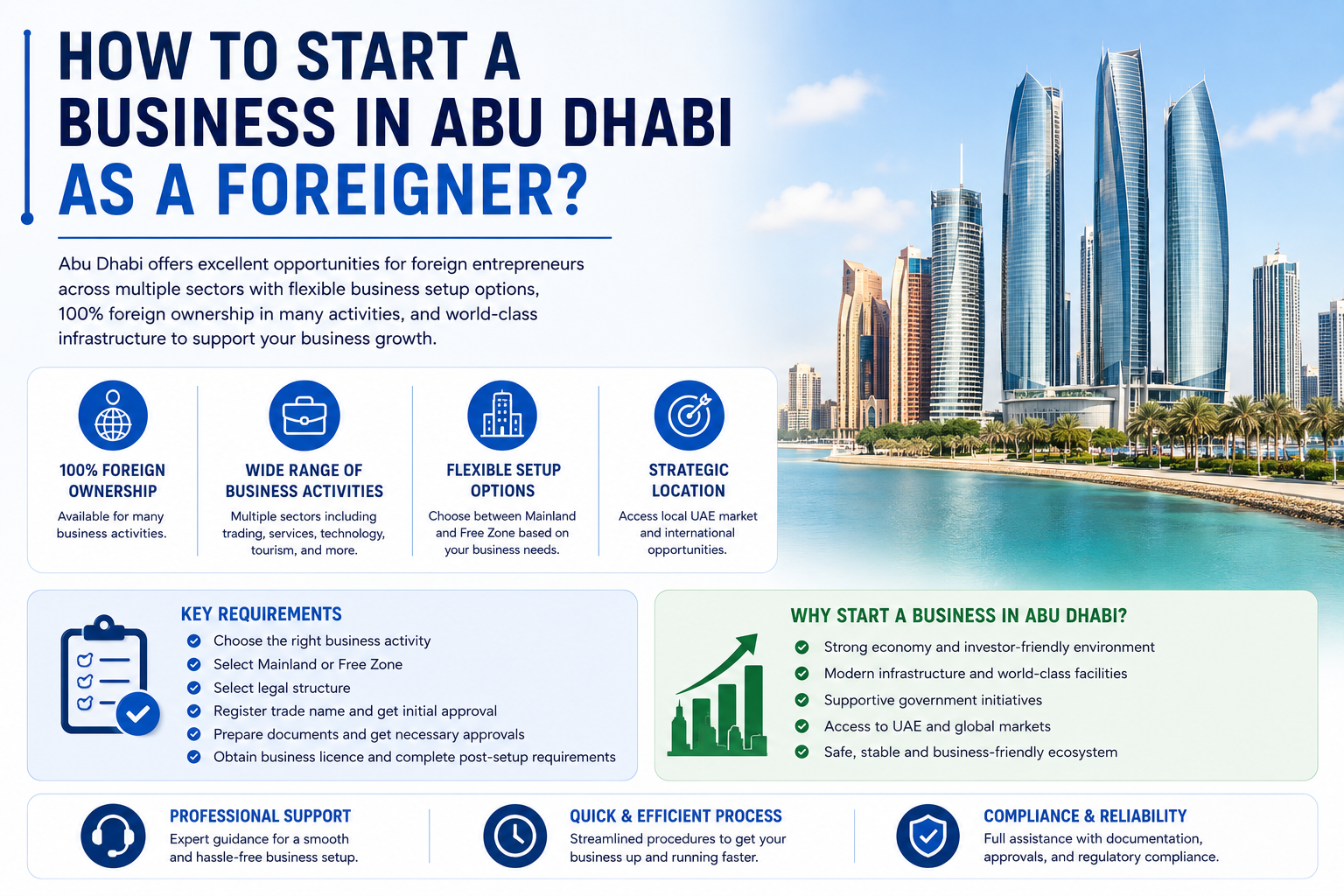
Abu Dhabi has become an attractive destination for foreign entrepreneurs and international investors looking to establish a business in the UAE. The emirate offers opportunities across sectors including professional services, trading, technology, tourism, manufacturing, and more.
Foreign investors can choose between Abu Dhabi Mainland and Free Zone business setups, depending on their business activity, target market, ownership requirements, office needs, and budget. Abu Dhabi also provides different licensing options designed for various types of businesses.
If you are planning to start a business in Abu Dhabi as a foreigner, understanding the company formation process before investing can help you select the right structure and avoid unnecessary complications.
Can a Foreigner Start a Business in Abu Dhabi?
Yes.
Foreign investors can establish businesses in Abu Dhabi, and many activities allow 100% foreign ownership.
However, ownership and licensing requirements can vary depending on:
- Business activity
- Legal structure
- Regulatory requirements
- Additional approvals
Certain regulated activities may also have additional conditions or approval requirements.
Foreign entrepreneurs can consider both Mainland and Free Zone company formation.
Do Foreigners Need a Local Emirati Partner in Abu Dhabi?
Not necessarily.
Many business activities can now be established with 100% foreign ownership, although certain regulated activities may have additional requirements.
Before selecting a legal structure, foreign investors should confirm whether their particular business activity qualifies for full foreign ownership.
This means foreign entrepreneurs should not automatically assume that an Emirati partner is required for every Abu Dhabi company.
Abu Dhabi Mainland vs Free Zone for Foreign Investors
One of the first decisions when starting a company in Abu Dhabi is choosing between Mainland and Free Zone.
Both can be suitable for foreign investors, but they serve different business requirements.
Abu Dhabi Mainland Business Setup
A mainland company can provide wider access to the UAE market.
The source highlights the flexibility of mainland businesses to conduct business throughout the UAE and access the local market without the restrictions associated with operating within a free zone.
A mainland setup may be suitable for businesses that:
- Want to serve customers throughout the UAE
- Need physical office or commercial premises
- Plan to work with local businesses
- Plan to work with government entities
- Want flexibility in business operations
- Require activities better suited to a mainland licence
Abu Dhabi Free Zone Business Setup for Foreigners
Abu Dhabi's Free Zones can be attractive to foreign investors looking for sector-focused business environments.
Free Zones generally provide 100% foreign ownership, while some also provide benefits such as streamlined setup procedures and repatriation of capital and profits.
A Free Zone may be suitable for:
- Startups
- International businesses
- Technology companies
- Service providers
- Export-oriented businesses
- Businesses seeking sector-specific ecosystems
The right choice should be based on your business model rather than simply choosing the cheapest option.
Mainland or Free Zone: Which Is Better for a Foreigner?
There is no single answer suitable for every foreign investor.
Consider Mainland if:
Your priority is broader access to the UAE market, local customers, government opportunities, or flexible mainland operations.
Consider a Free Zone if:
Your business is internationally focused, export-oriented, technology-based, service-based, or benefits from a specialised industry ecosystem.
When comparing the two, consider:
Target Customers → UAE Market Access → Ownership → Office → Visas → Cost → Regulations → Future Expansion
Step-by-Step Guide to Starting a Business in Abu Dhabi as a Foreigner
The process varies depending on your business activity, legal structure, jurisdiction, and regulatory requirements.
The following are the main steps identified in the source.
Step 1: Decide on Your Business Activity
The first step is determining exactly what your company will do.
Abu Dhabi provides several categories of economic licences, including:
- Commercial
- Professional
- Industrial
- Tourism
- Agricultural
- Occupational
Your chosen activity can influence:
- Licence type
- Legal structure
- Required approvals
- Office requirements
- Regulatory requirements
Selecting the correct activity from the beginning can help prevent complications later.
Step 2: Choose Mainland or Free Zone
Once you have determined the activity, decide whether Mainland or Free Zone incorporation is more appropriate.
Consider:
- Target customers
- UAE market access
- Ownership
- Office requirements
- Visa requirements
- Business costs
- Industry-specific regulations
- Future expansion plans
The decision should ultimately reflect your long-term business objectives.
Step 3: Select the Legal Structure
The next stage is selecting a legal form appropriate for the business activity and ownership arrangement.
Possible structures identified in the source include:
- Limited Liability Company (LLC)
- Sole Establishment
- Partnership structures
- Branch of a foreign company
- Other permitted legal forms
The appropriate structure depends on the company's activity, ownership arrangement, and regulatory requirements.
Step 4: Choose and Register a Trade Name
Once the business structure and activity have been determined, select an appropriate company name.
The proposed name must:
- Comply with applicable UAE and Abu Dhabi naming requirements
- Be available for registration
Trade-name registration is one of the important steps before obtaining the final business licence.
Step 5: Apply for Initial Approval
The next stage is obtaining initial approval.
According to the source, Abu Dhabi's Department of Economic Development (ADDED) requires investors to apply for initial approval to proceed with the company setup process.
Depending on the activity, additional government approvals may also be required.
Step 6: Prepare the Required Documents
Foreign entrepreneurs need to provide documentation according to the selected business activity and legal structure.
Documents may include:
- Passport copies
- Shareholder or partner information
- Trade-name documents
- Initial approval documents
- Memorandum of Association, where applicable
- Tenancy or lease documentation
- Activity-specific approvals
- Other supporting documents requested by authorities
Because the exact requirements vary, the documentation should be checked before submission.
Step 7: Arrange a Business Location
Depending on the business activity and licence, you may need a suitable:
- Office
- Commercial premises
- Business location
- Tenancy contract
The source states that selecting an appropriate location and obtaining a tenancy contract can form part of the Abu Dhabi business establishment process.
For businesses that do not require physical premises, certain online licensing options may be available.
Step 8: Obtain Additional Government Approvals
Some activities require approval from additional government or regulatory authorities.
Examples identified in the source include businesses operating in:
- Healthcare
- Tourism
- Food
- Education
- Construction
- Finance
- Manufacturing
- Other regulated industries
The exact approvals depend on the activity and location.
Step 9: Apply for the Abu Dhabi Business Licence
After completing the required documentation, approvals, and applicable payments, the entrepreneur can proceed with the business licence application.
Abu Dhabi provides economic licensing services through relevant government channels, including TAMM.
Once issued, the licence allows the company to legally conduct its approved economic activity.
Step 10: Complete Post-Setup Requirements
Obtaining your business licence is an important milestone, but it may not complete the entire setup process.
Depending on the company, additional requirements may include:
- Establishment and immigration requirements
- Investor visas
- Employee visas
- Emirates ID procedures
- Corporate bank account
- Applicable tax registrations
- Accounting and compliance
- Labour-related requirements
- Annual licence renewal
Proper post-setup compliance helps the company operate legally and avoid unnecessary penalties.
Abu Dhabi Business Setup Process for Foreigners at a Glance
The general process can be summarised as:
Choose Business Activity → Mainland or Free Zone → Select Legal Structure → Register Trade Name → Obtain Initial Approval → Prepare Documents → Arrange Business Location → Obtain Additional Approvals → Apply for Business Licence → Complete Post-Setup Requirements
This process can vary according to the exact business activity and company structure.
What Are the Main Business Licences Available in Abu Dhabi?
The appropriate licence depends mainly on the business activity.
Commercial Licence
Generally suitable for businesses involved in trading and commercial activities.
Professional Licence
Designed for certain professional and service-based activities.
Industrial Licence
Suitable for businesses involved in manufacturing and industrial activities.
Tourism Licence
Applicable to eligible tourism-related activities.
Abu Dhabi also provides specialised licensing options, including Freelancer and Virtual Licences for eligible activities and applicants.
Can I Start a Business in Abu Dhabi From Outside the UAE?
Yes, certain licensing options are available to investors residing outside the UAE.
The source specifically states that ADDED lists a Virtual Licence for individuals residing outside the country who want to start a business in Abu Dhabi.
However, eligibility and requirements depend on the:
- Licence
- Business activity
This can make Abu Dhabi particularly interesting for international entrepreneurs exploring UAE business opportunities before relocating.
How Much Does It Cost to Start a Business in Abu Dhabi as a Foreigner?
There is no single fixed cost for starting a business in Abu Dhabi.
The overall cost depends on:
- Business activity
- Mainland or Free Zone
- Licence type
- Legal structure
- Office requirements
- Number of visas
- Government approvals
- Registration fees
- Additional regulatory requirements
For this reason, foreign investors should calculate their complete company formation cost based on the actual business requirements instead of relying on one advertised licence price.
What Costs Should a Foreign Investor Consider?
When budgeting for Abu Dhabi company formation, consider the complete setup rather than only the licence.
Potential expenses can arise from:
Business Licence + Registration + Office + Visas + Government Approvals + Regulatory Requirements
The exact amount depends on the proposed business structure and activity.
What Is the Cheapest Way to Start a Business in Abu Dhabi?
The supplied source does not identify one universally cheapest company formation option.
Instead, it specifically recommends choosing based on the business model rather than simply selecting the cheapest option.
This is important because a low-cost licence may not necessarily provide the:
- Activities you require
- Market access you need
- Visa allocation you need
- Office arrangement you need
- Long-term expansion structure you need
The right setup should therefore balance cost with operational requirements.
Can I Get 100% Foreign Ownership in Abu Dhabi?
For many activities, yes.
Foreign investors can establish businesses in Abu Dhabi, and many activities permit 100% foreign ownership, subject to applicable regulations.
However, foreign investors should confirm their exact activity because regulated businesses can have specific conditions.
Common Mistakes Foreign Investors Should Avoid
Choosing the Cheapest Licence Without Checking Market Access
Your setup should match your business model rather than simply being the cheapest option.
Selecting the Wrong Business Activity
The activity affects your licence, legal structure, approvals, office requirements, and regulatory obligations.
Ignoring Additional Approvals
Businesses in regulated industries may require approvals beyond the basic economic licence.
Ignoring Post-Licensing Requirements
The process may continue after licence issuance through visas, immigration, banking, tax, accounting, labour compliance, and annual renewal.
Choosing Mainland or Free Zone Without a Long-Term Plan
The decision should consider target customers, UAE market access, visas, costs, regulations, and future expansion.
Why Use Professional Business Setup Services?
Starting a company involves much more than obtaining a trade licence.
Foreign entrepreneurs need to make decisions regarding:
- Business activity
- Legal structure
- Jurisdiction
- Approvals
- Documentation
Professional business setup support can assist with:
- Choosing an appropriate business structure
- Mainland and Free Zone comparison
- Trade-name registration
- Initial approval
- Document preparation
- Licence application
- Government submissions
- Visa and PRO support
- Corporate bank account guidance
- Post-setup compliance
Why Choose Fimkin for Business Setup in Abu Dhabi?
Fimkin Business Services provides business setup assistance for entrepreneurs and companies establishing operations in Abu Dhabi.
Support covers both Mainland and Free Zone options, helping clients understand the appropriate:
- Company structure
- Licensing requirements
- Documentation
- Post-setup procedures
Fimkin's Abu Dhabi business setup service also provides assistance with:
- Activity and structure selection
- Name reservation
- Initial approval
- Document submission
- Licence issuance
- Bank guidance
- Visa and PRO support
Start Your Business in Abu Dhabi with Fimkin
If you are an international entrepreneur looking to open a company in Abu Dhabi, selecting the right structure from the beginning can help avoid unnecessary delays, additional expenses, and licensing complications.
Before starting, determine your:
Business Activity → Target Market → Mainland or Free Zone → Legal Structure → Ownership → Office → Visas → Approvals → Total Budget
Fimkin Business Services can assist throughout the business setup and post-setup process.
Related Service: Abu Dhabi Business Setup Services
https://www.fimkinonline.com/services/58e1b473-7dfe-4b36-8d9f-c41d249d2d08
Frequently Asked Questions
Can a foreigner start a business in Abu Dhabi?
Yes. Foreign investors can establish businesses in Abu Dhabi, and many activities permit 100% foreign ownership, subject to applicable regulations.
Is a local Emirati partner required?
Not universally. Many activities allow full foreign ownership, although certain regulated activities may have specific conditions.
Should a foreigner choose Mainland or Free Zone?
It depends on the business. Mainland companies offer wider UAE market access, while Free Zones can provide sector-specific advantages and 100% foreign ownership.
What documents are required to start a business in Abu Dhabi?
Requirements vary according to the activity and legal structure. Documents may include passport copies, trade-name documents, initial approvals, constitutional documents, tenancy documentation, and activity-specific approvals.
How much does it cost for a foreigner to start a company in Abu Dhabi?
There is no single fixed amount. Costs depend on the activity, jurisdiction, licence, legal structure, office, visas, approvals, registration fees, and other regulatory requirements.
Can I open an Abu Dhabi company while living abroad?
Certain licensing options are available to investors outside the UAE. The source specifically identifies the Abu Dhabi Virtual Licence for eligible individuals residing outside the country.
Do I need an office?
It depends on the activity and licence. A suitable business location and tenancy contract may be required, while certain online licensing options may be available for businesses that do not require physical premises.
Which licence do I need?
The appropriate licence depends on the business activity. The source identifies commercial, professional, industrial, tourism, and other specialised licensing options.
How long does it take to start a business in Abu Dhabi?
The timeline varies according to the business activity, jurisdiction, approvals, documentation, and licence type. The source states that Fimkin currently estimates typical mainland formation at around 2–4 weeks, while some Free Zone setups may be completed faster.
Can Fimkin help foreign investors start a business in Abu Dhabi?
Yes. Fimkin provides support for Mainland and Free Zone company formation, including structure selection, licensing requirements, documentation, name reservation, initial approval, licence issuance, bank guidance, and visa/PRO support.
Conclusion
Starting a business in Abu Dhabi as a foreigner is an achievable opportunity, but choosing the correct business activity, jurisdiction, legal structure, and licence is essential.
Many activities offer 100% foreign ownership, while investors can choose between Mainland and Free Zone structures according to their target market and operational requirements.
For first-time investors, professional guidance can help simplify company formation and reduce avoidable documentation errors and delays. Fimkin Business Services provides support across company formation, licensing, documentation, visa assistance, and post-setup requirements.